Chassis No.
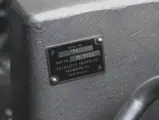
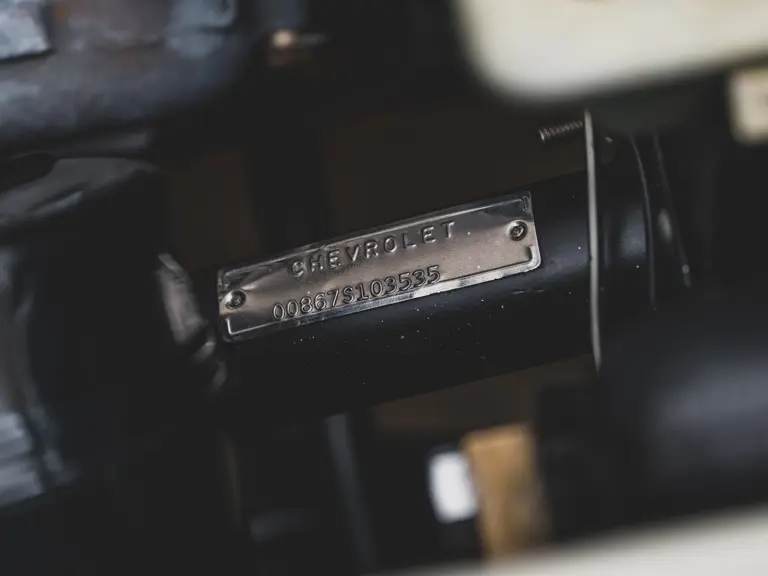
00867S103535
$2,000,000 - $2,500,000 USD | Not Sold
{{bidding.lot.reserveStatusFormatted}}
Briggs Swift Cunningham II, an American sportsman, inherited a significant fortune from his father, a successful businessman noted for having founded and run Citizens National Bank in addition to financing Procter & Gamble. While unable to access full control of his inheritance until age 40, Cunningham wasted no time making a name for himself in racing behind the wheel, with success in early SCCA events.
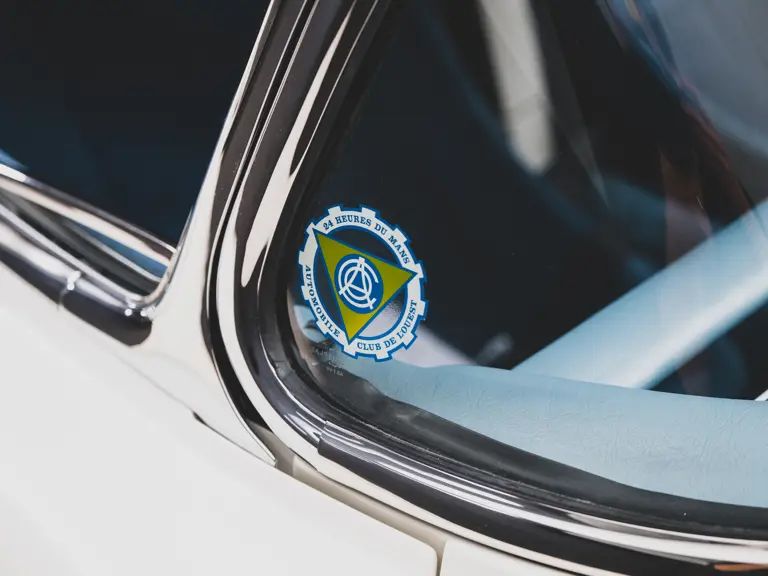
In 1950 Cunningham privately entered a pair of Cadillacs in the 24 Hours of Le Mans: A Series 61 Coupe nicknamed “Petit Pataud” and a custom-bodied Series 61 Spyder nicknamed “Le Monstre.” The cars would finish 10th and 11th overall. Despite finishing the race, the effort proved the need for a purpose-built racecar to be truly competitive with the best that Europe had to offer.
In September 1950, Briggs formed B.S. Cunningham in Palm Beach, Florida. The company would produce hand-built cars to compete directly with the likes of Ferrari on the world’s biggest stage, the 24 Hours of Le Mans. Cunningham would field his own cars with American drivers at Le Mans in 1951, 1952, 1953, 1954, and 1955. While 1951 saw each Cunningham entry DNF, the team would finish 4th overall and win their class in 1952 with Briggs Cunningham and William “Bill” Spear behind the wheel of a C-4R. The success would continue for Cunningham’s upstart marque with 3rd overall finishes and class wins in both 1953 and 1954. The marque’s final entry at Le Mans came in 1955, with a C6-R raced by Cunningham himself as well as Sherwood Johnston. They completed 196 laps when, in hour 19, a piston failure ended their race.
Despite the successes in racing, Cunningham road car production never reached a point to cover expenses, leading Briggs Cunningham to fold his namesake car company at the end of 1955. This would not be the end, however, of Cunningham’s quest to win Le Mans.
AN ALL-AMERICAN EFFORT AT LE MANS
By the mid-1950s Zora Arkus-Duntov, with the help of Corvette designer and creator Harley Earl, had managed to convince the powers at General Motors to develop a purpose-built factory racecar. With eyes set on the 24 Hours of Le Mans, Arkus-Duntov and a small team developed the 1957 Chevrolet Corvette SS. Sadly, the SS would only compete in that year’s 12 Hours of Sebring; the project was shelved in June of 1957 following the Automobile Manufacturers Association (AMA) racing ban. Despite the ban, Arkus-Duntov continued to support teams racing the Corvette behind the scenes.
Having witnessed the progression and successes of Cummingham and his team at Le Mans in the 1950s, Arkus-Duntov approached Briggs Cunningham in the fall of 1959 with a pitch: Cunningham would return to Le Mans and manage a team of Corvettes, which would be supported by the factory on strictly unofficial terms. An agreement was made with Cunningham on 7 January 1960, and later that same month Arkus-Duntov’s team began building racing engines for the Cunningham effort.
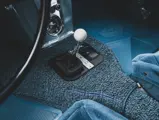
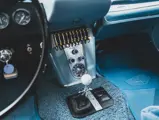
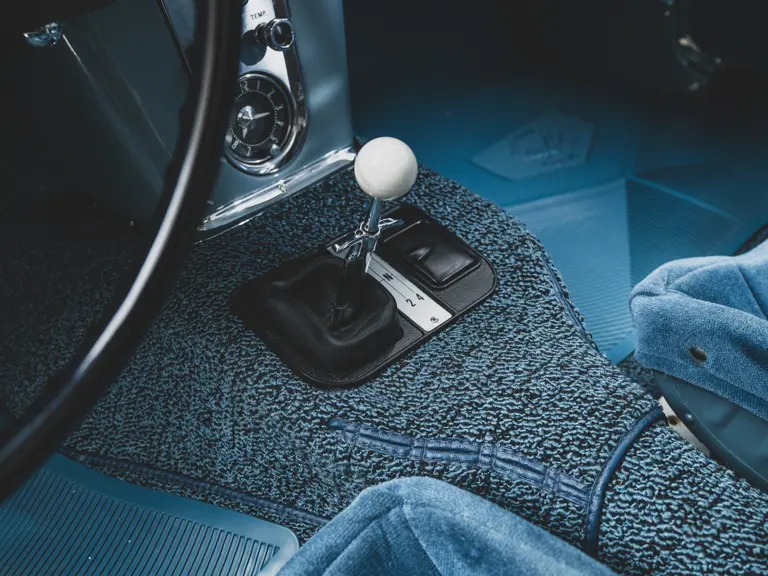
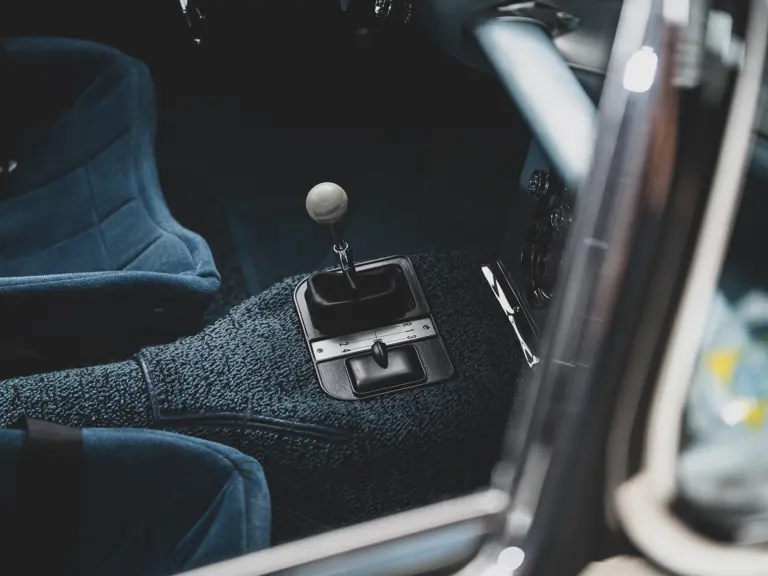
It was important that Chevrolet’s involvement was not made public, as the company was still overtly adhering to the AMA ban. The project thus began with the Corvettes for Le Mans being acquired via a dealer, rather than direct from the factory. On 16 March 1960, three Corvettes were purchased by Cunningham’s New York-based Jaguar distributor on Long Island from Don Allen Midtown Chevrolet in New York City—proudly advertised in period as “The Largest Corvette Dealer.” To the untrained eye each appeared to be a normal Corvette; however, these special-order examples each featured a temperature-controlled radiator fan, quick-ratio steering, a close-ratio four-speed manual transmission, a Posi-Traction limited-slip differential, heavy-duty suspension, heavy-duty sintered-metallic brake linings, and heavy-duty brakes.
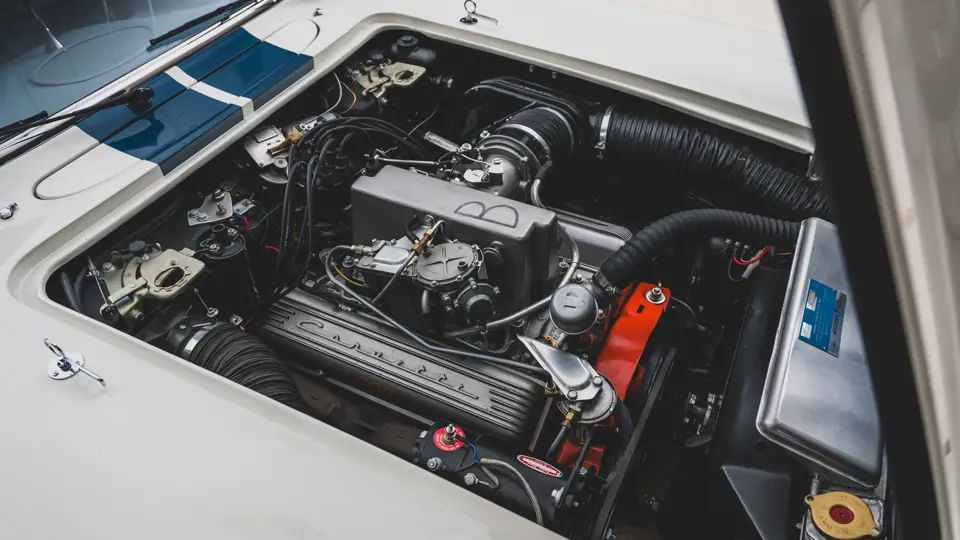
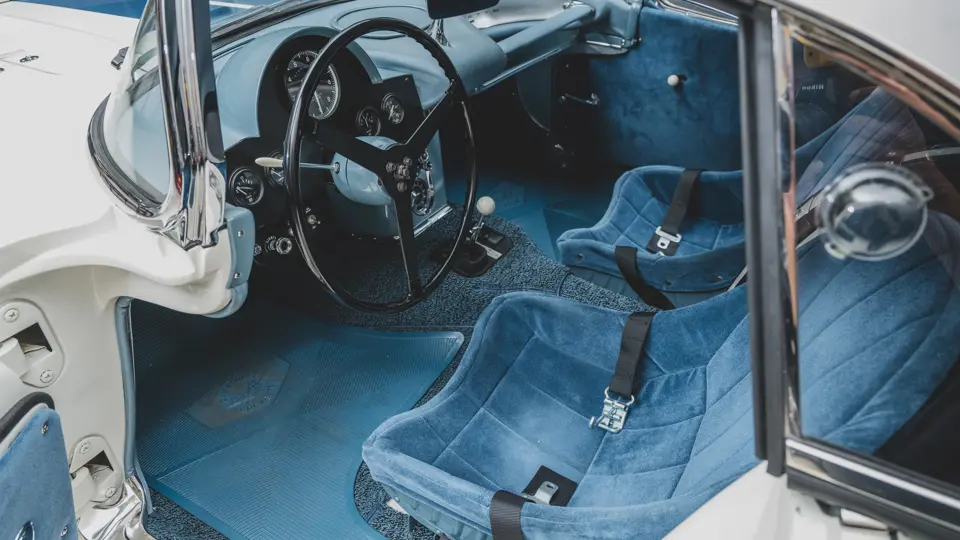
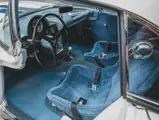
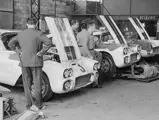
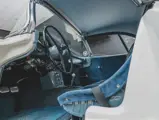
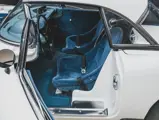
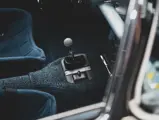
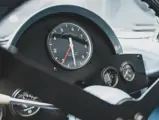
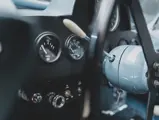
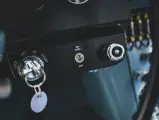
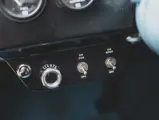
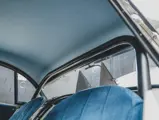
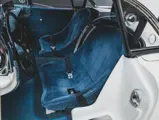
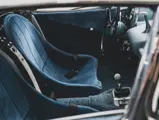
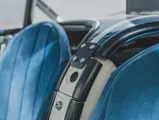
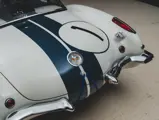
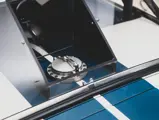
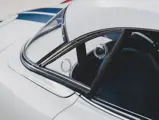
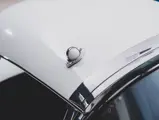
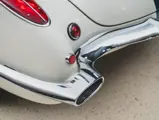
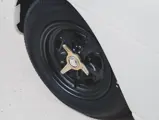
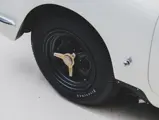
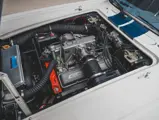
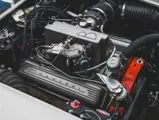
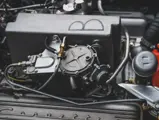
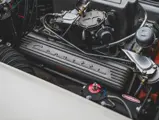
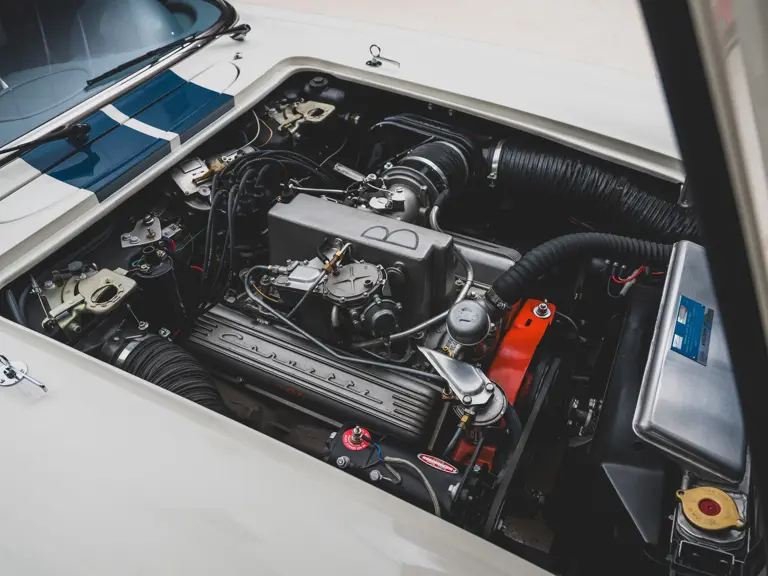
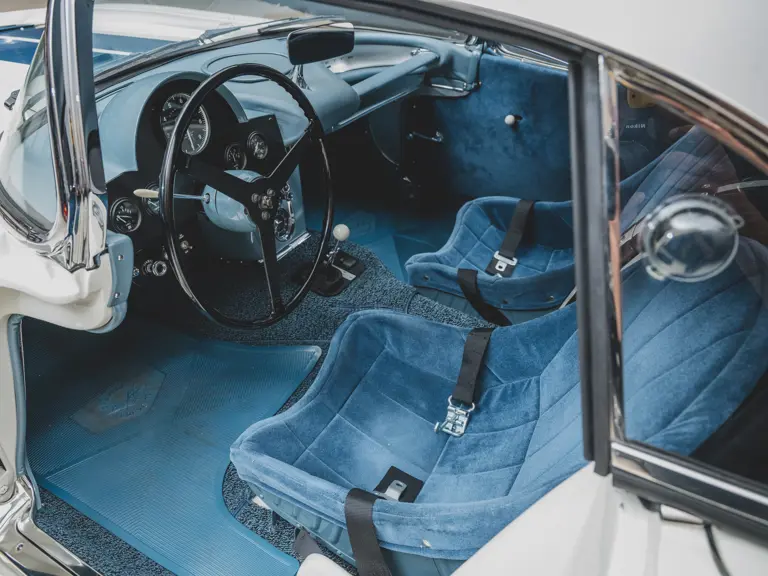
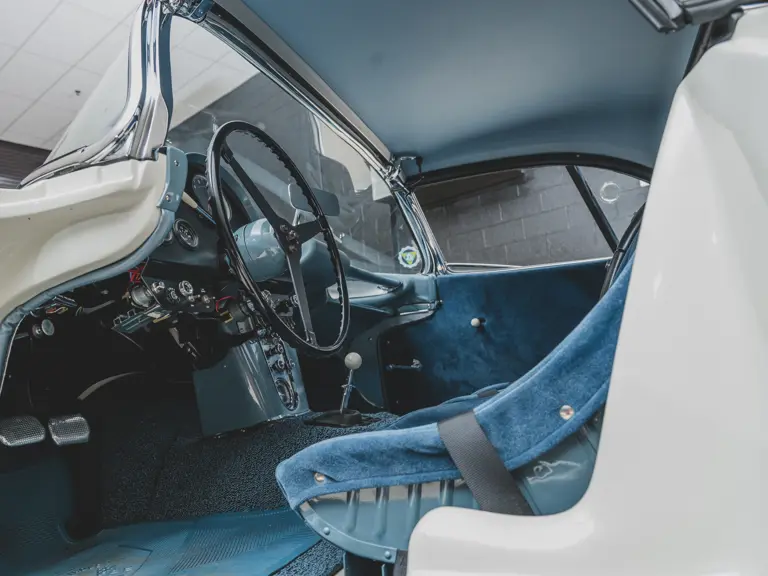
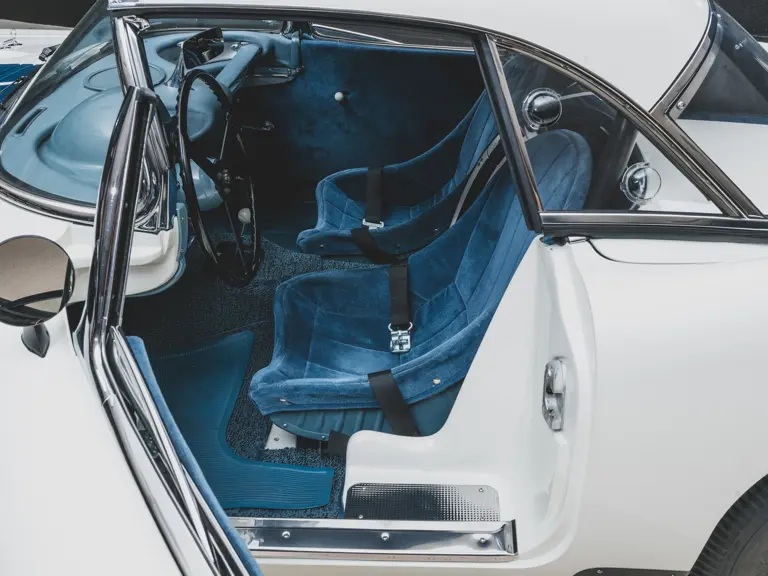
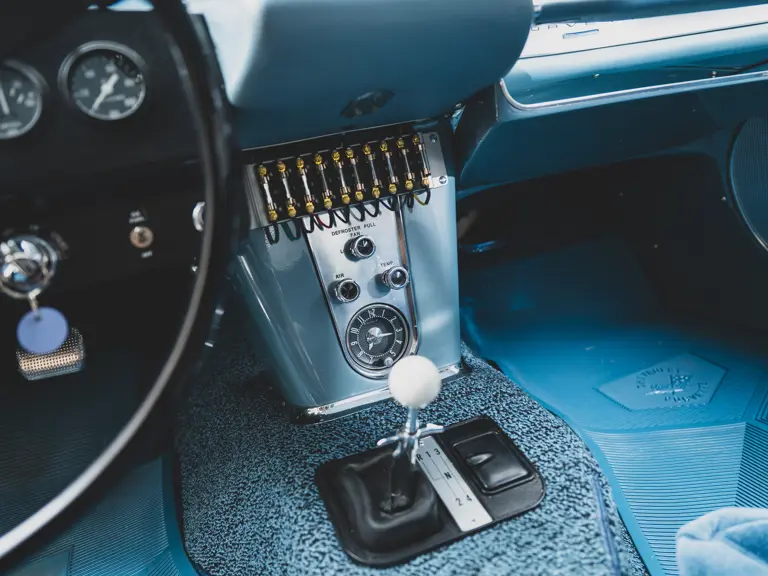
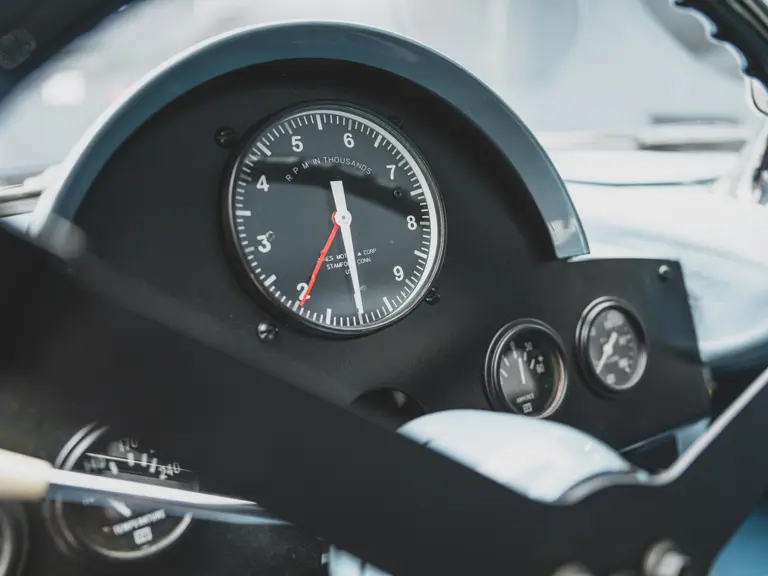
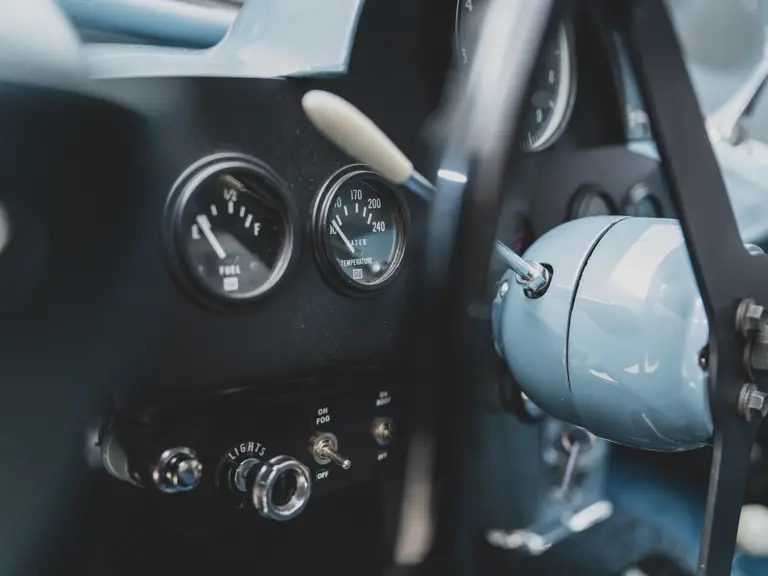
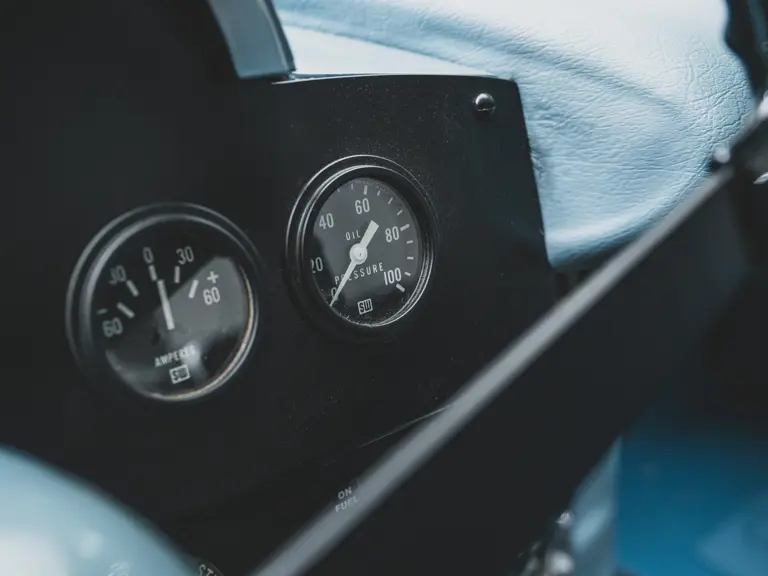
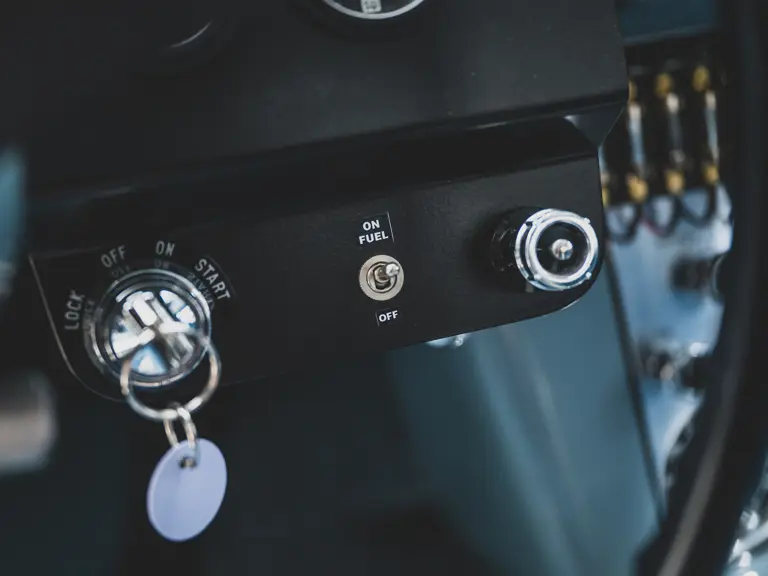
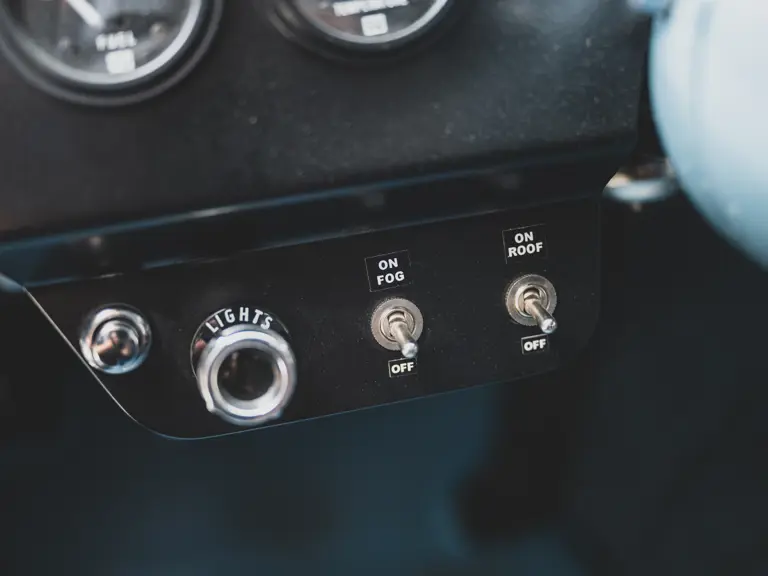
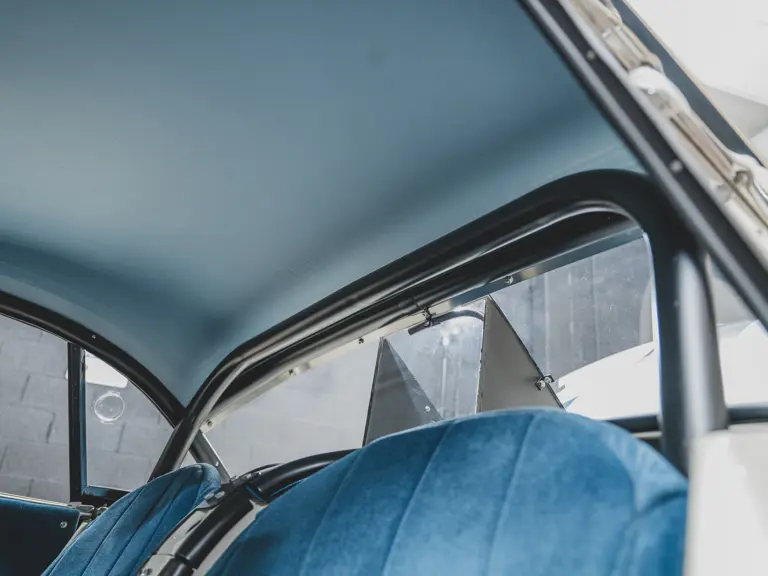
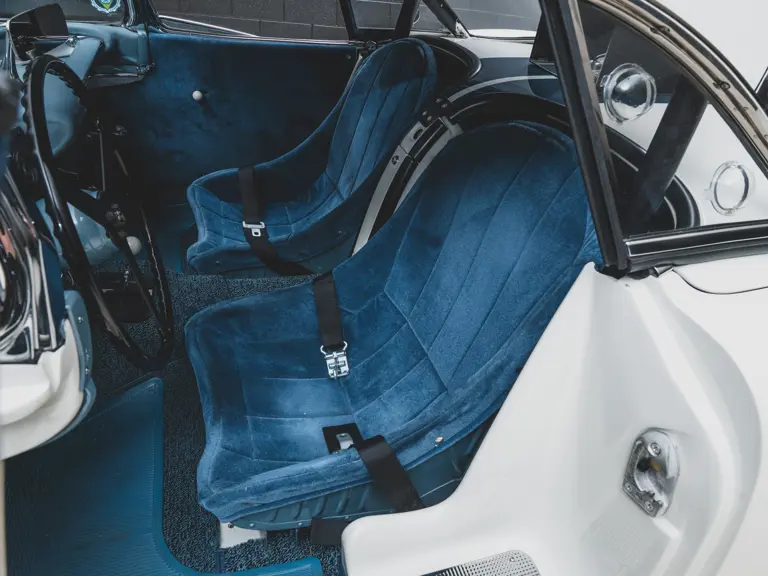
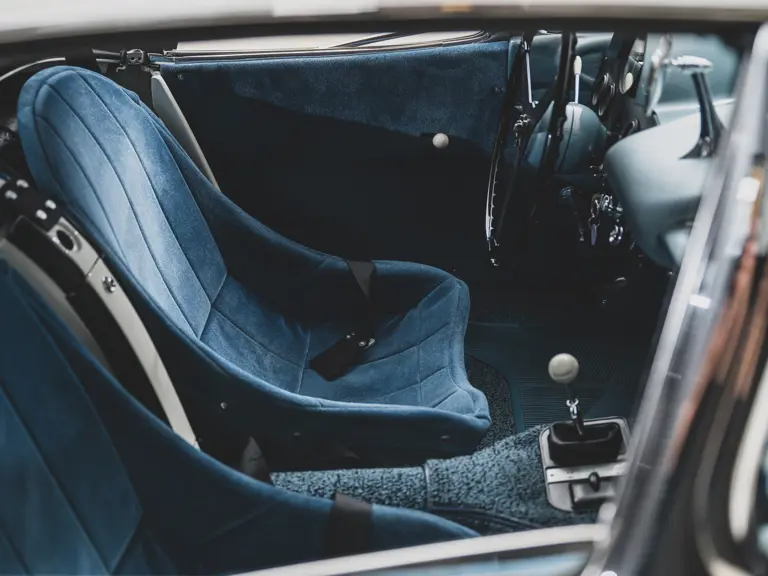
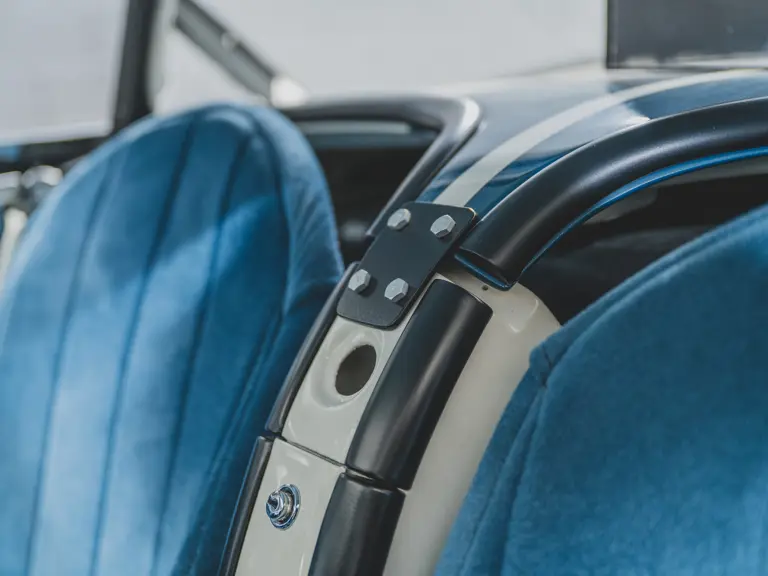
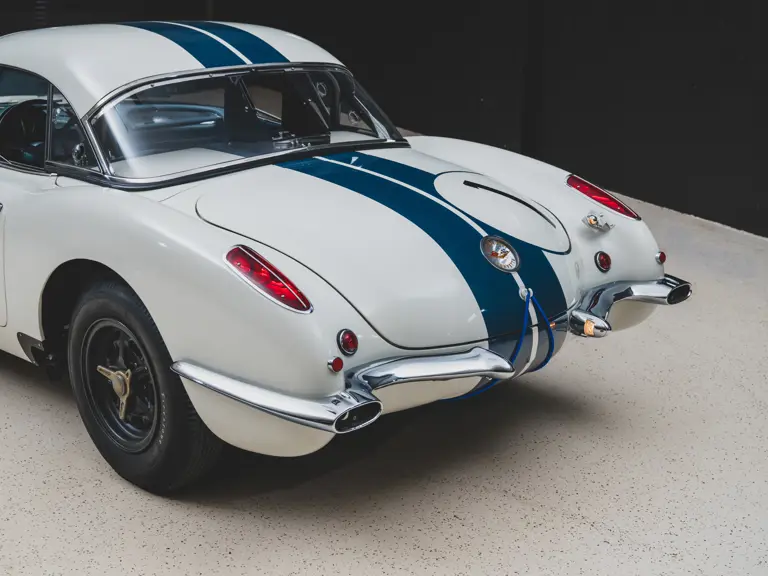
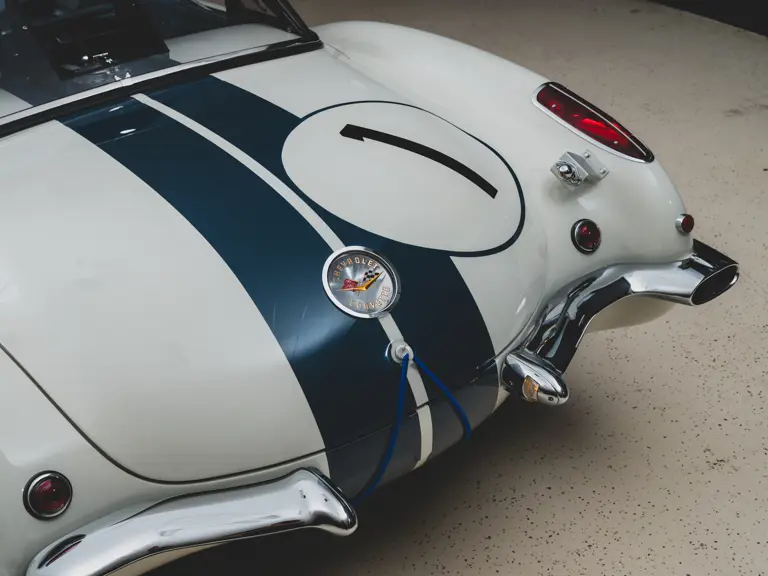
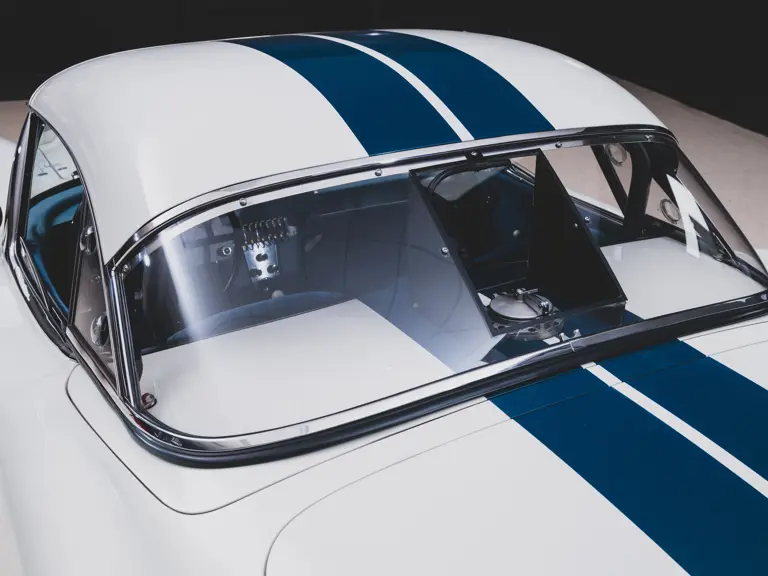
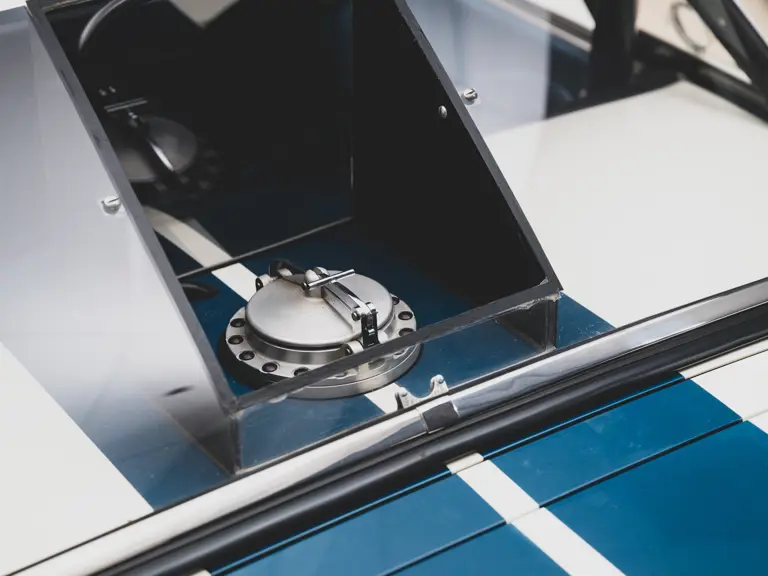
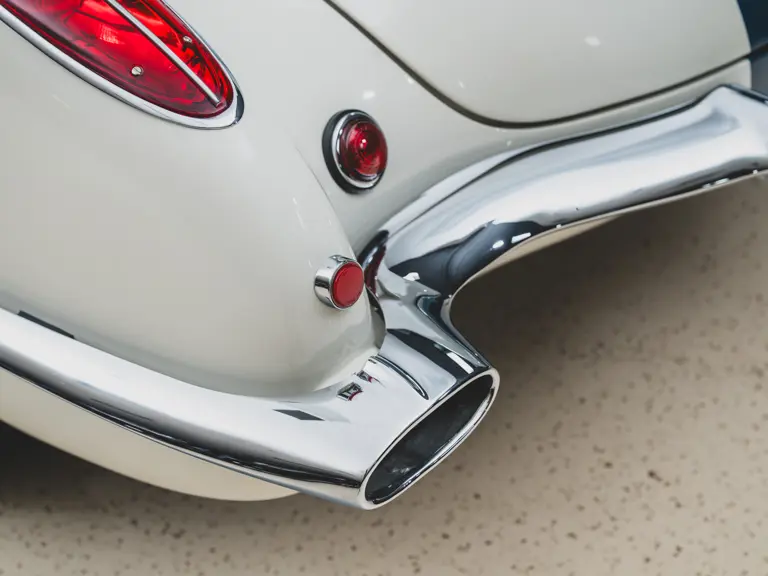
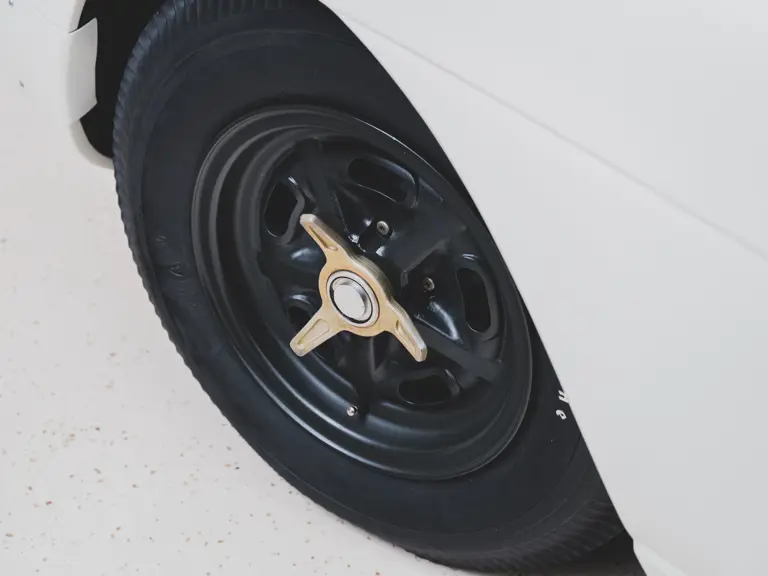
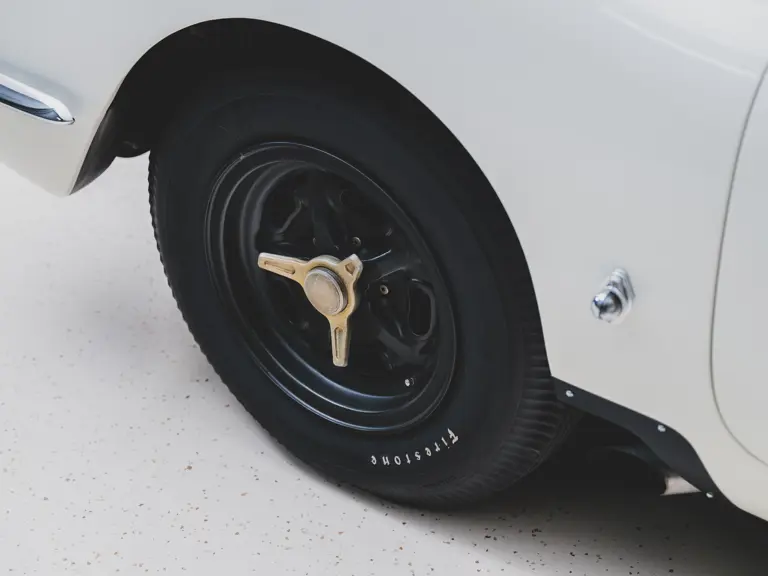
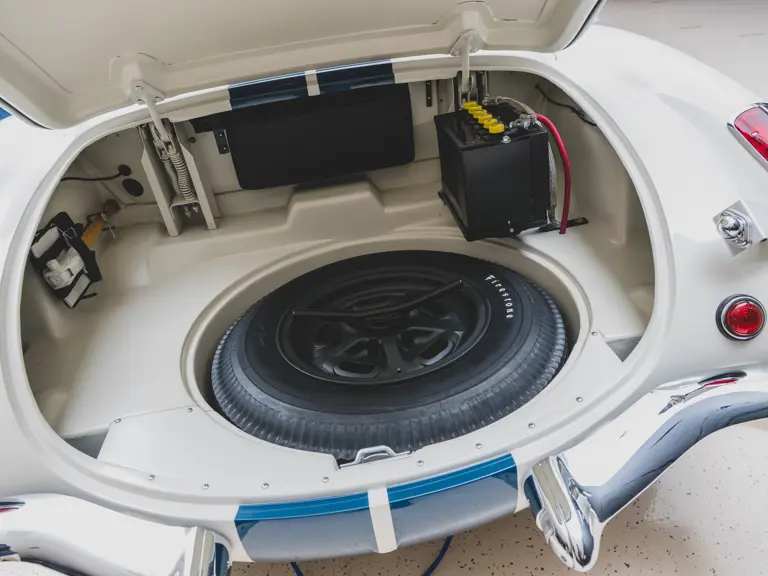
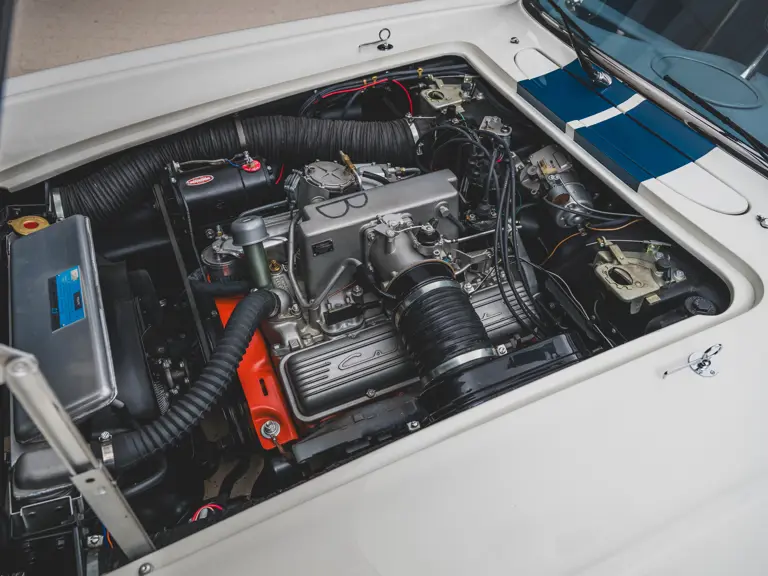
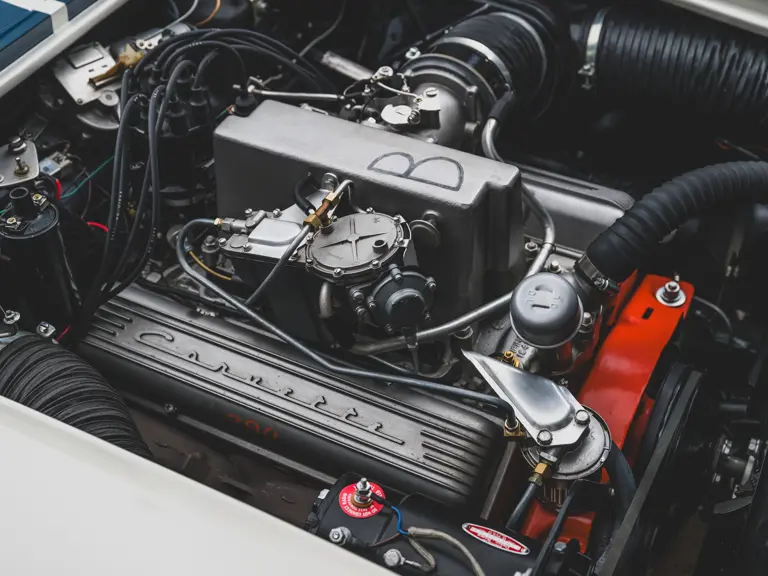
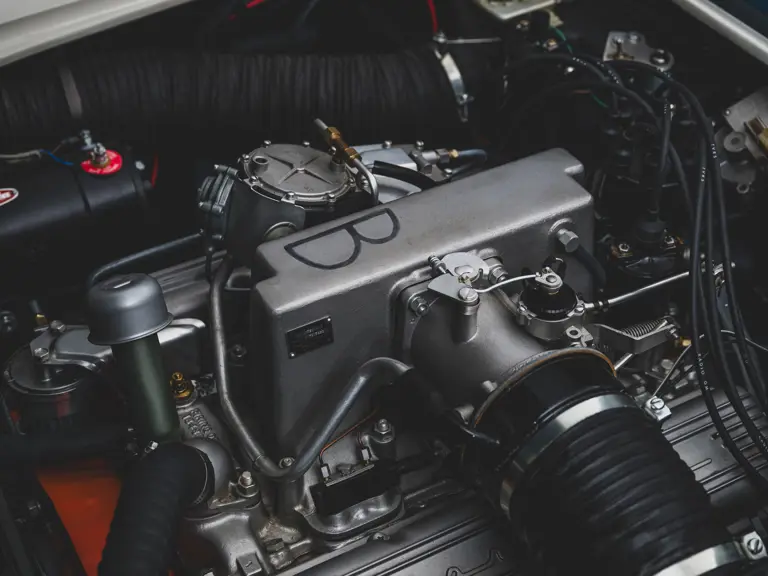
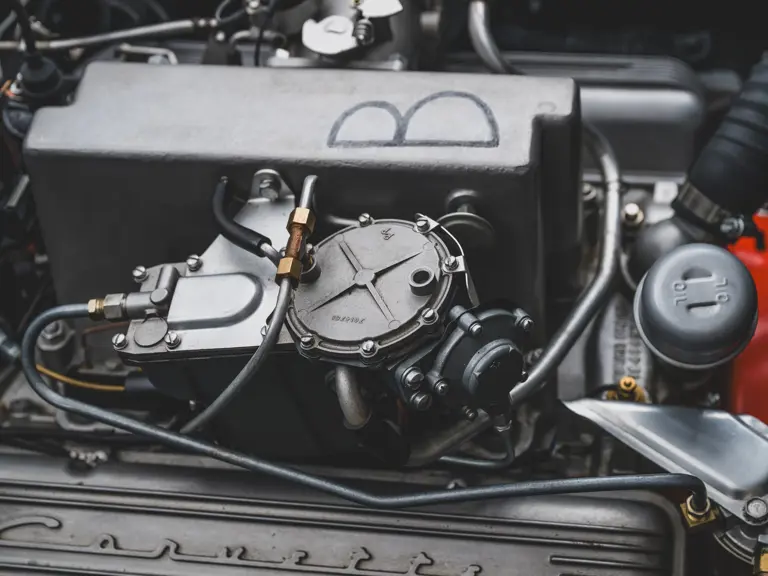
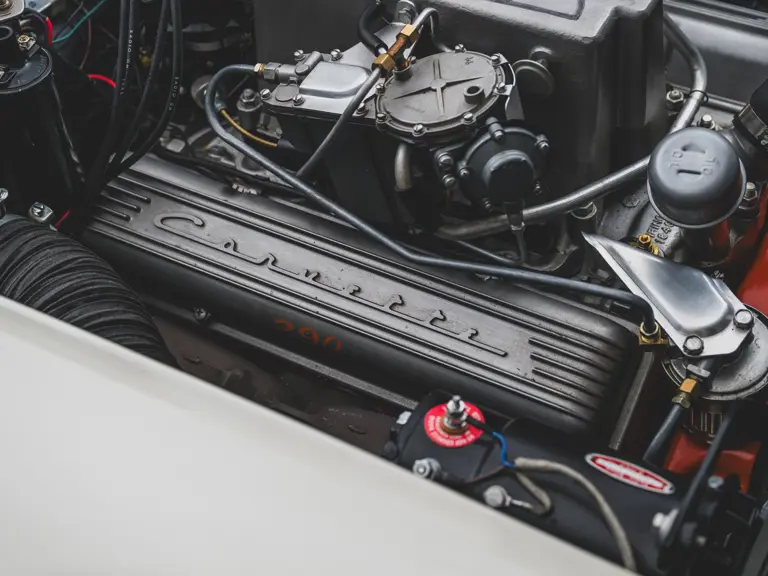
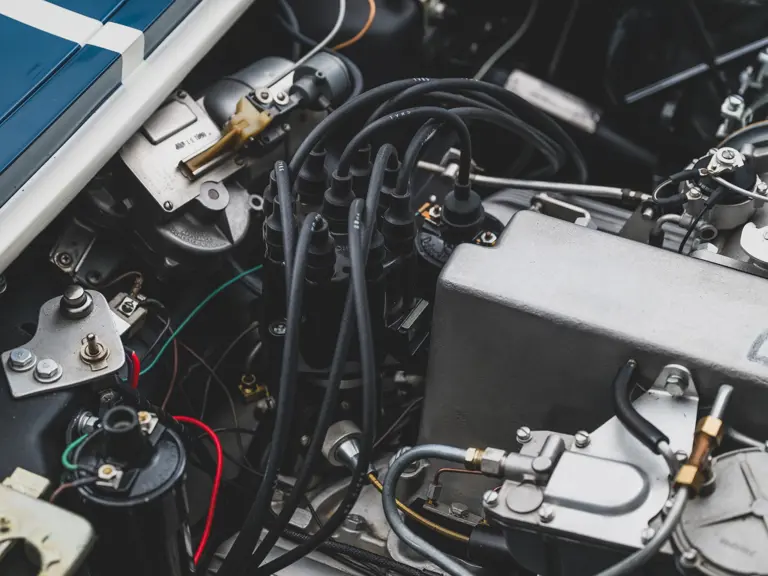
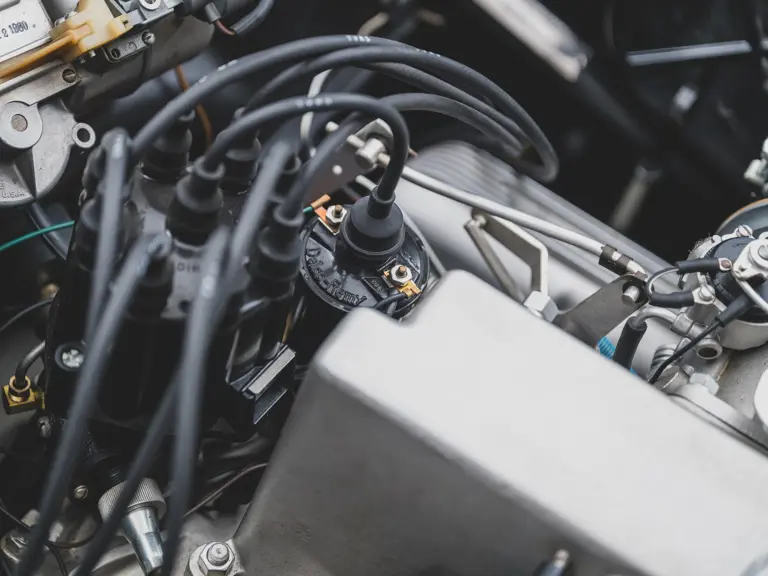
The three cars were further modified by Cunningham’s friend and race team manager, Alfred Momo. It was at The Momo Corporation in Woodside, New York, a neighborhood of Queens, that Momo’s crew installed a set of Halibrand magnesium wheels with Firestone racing tires, added an additional front sway bar, Koni competition shock absorbers, a high-capacity fuel tank with a center-mounted Halibrand quick release fuel cap, Bendix fuel pumps (primary and backup), side-exit racing exhaust, more accurate Stewart Warner instrumentation, and two lightweight seats from a Douglas C-47 Skytrain aircraft. The stock engines were pulled and replaced with race-spec fuel-injected engines provided by Zora Arkus-Duntov’s engineering team.
TESTING AND THE 12 HOURS OF SEBRING
In mid-March 1960 the GM team went to Florida for testing, initially at Sebring and then Daytona. There, over a five-day period, Zora Arkus-Duntov and Paul Goldsmith tested and fine-tuned the engine and suspension, in addition to testing different axle ratios and tires.
Shielding GM from any involvement, Cunningham entered two Corvettes under his Jaguar distributor of New York for the 1960 12 Hours of Sebring. According to NCRS Corvette Restorer magazine, the two cars were chassis 2538, competing under #1 driven by Briggs Cunningham as well as fellow American and noted Corvette driver and former team manager, John Fitch; and chassis 3535, this car, competing under #2 with Americans Dick Thompson and Fred Windridge sharing driving duties.
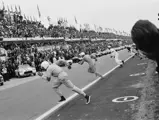
Sebring rules stipulated starting order was done by engine displacement, with a Le Mans-style running start for the drivers. The first six cars in the starting line were Chevrolet Corvettes, and at the very front were the two Cunningham cars: #1 (chassis 2538) and #2 (this car, chassis 3535).
The first official outing for the Cunningham Corvettes proved difficult on the challenging Sebring course. At lap 27, chassis 2538 suffered major damage following a rear hub failure, and the car flipped over. Luckily driver John Fitch, who was behind the wheel at the time, escaped major injury. Chassis 3535’s day would come to an end early as well, suffering an engine failure at the hairpin turn, forcing its retirement after 41 laps. Despite the results, data gained from practice and the race itself proved valuable for the further development of the Corvette for Le Mans.
THE 1960 24 HOURS OF LE MANS
With the third Cunningham Corvette not yet completed, and chassis 2538 requiring repairs from the accident at Sebring, it is believed that this car, chassis 3535, was the car that received a 1959 engine with cast iron cylinder heads and was flown to France via Pan Am air freight from New York for the Le Mans practice session. On 9 April 1960 the Corvette completed over 520 test miles of the Circuit de la Sarthe, with Briggs Cunningham and Dick Thompson splitting driving duties. According to AOC Test Day report, the Corvette achieved a top speed of 180.617 km/h (~112.5 mph) and a best lap time of 4:28.3, impressively putting the Cunningham Corvette just behind a pair of V-12 Ferraris in both categories.
Notes gathered from Florida testing, the Sebring race, and Le Mans testing were analyzed and numerous further changes were made. On 17 May 1960 at Bridgehampton, New York, the team would test for the final time on American soil prior to the 24 Hours of Le Mans. There, Zora Arkus-Duntov, John Fitch, and Bob Grossman would complete over 300 laps of the famed Long Island track, gathering additional data and making last-minute adjustments.
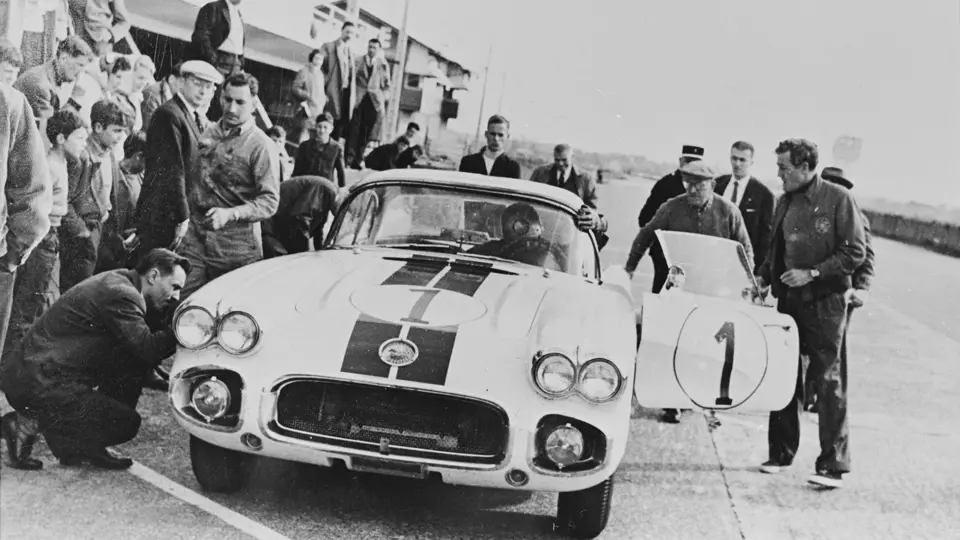
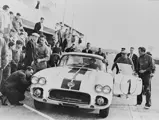
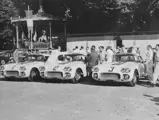
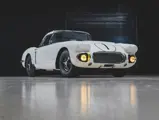
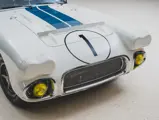
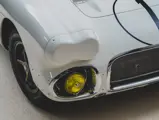
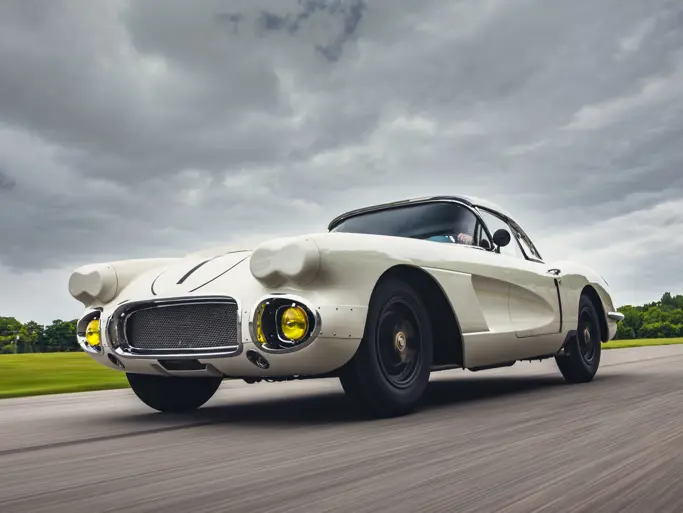
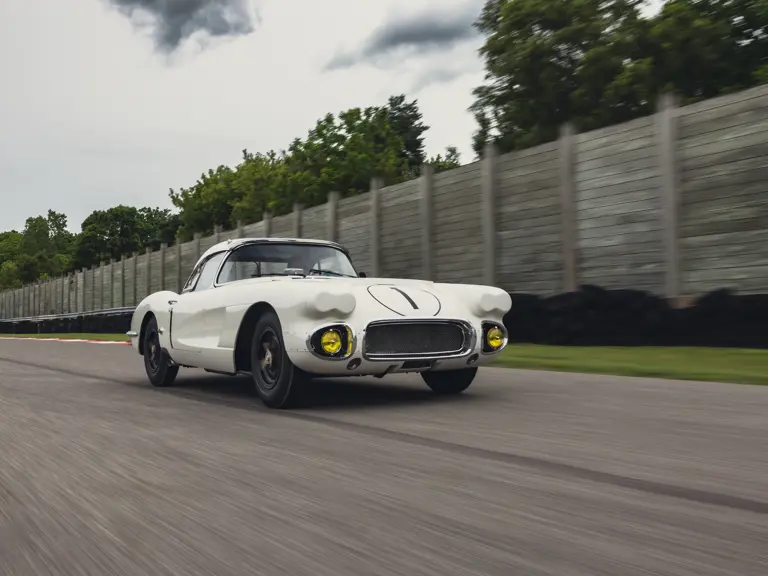
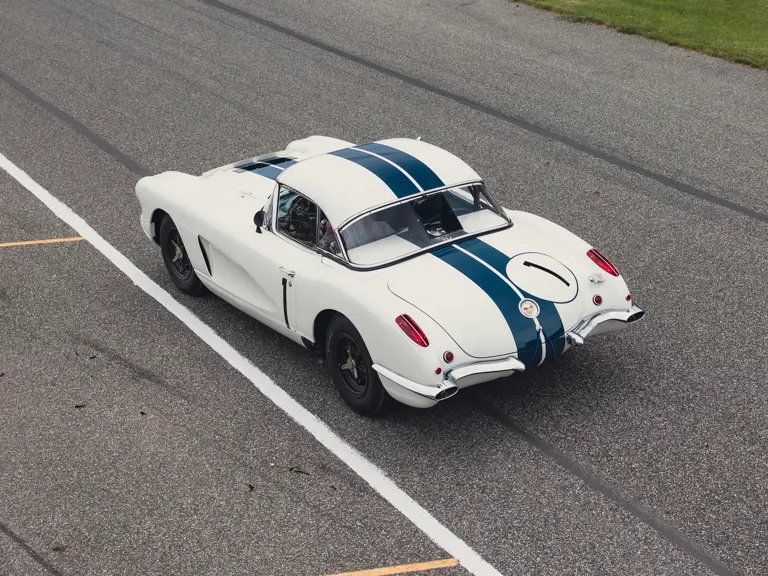
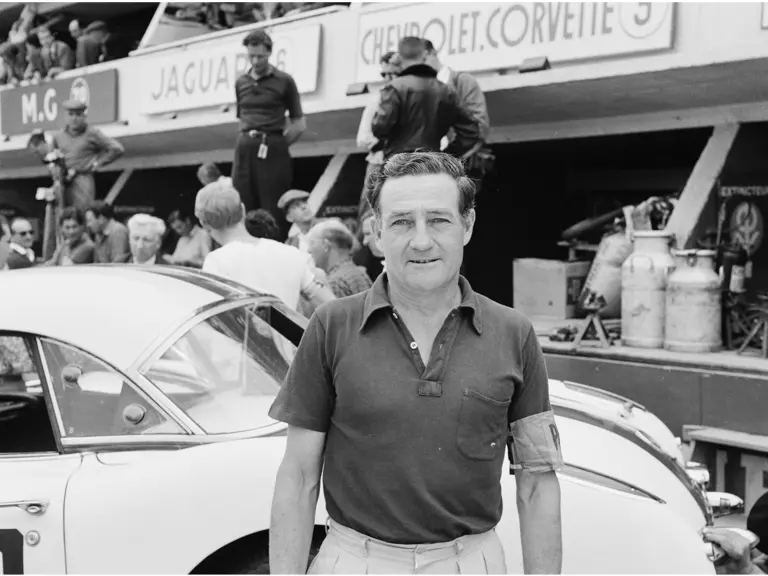
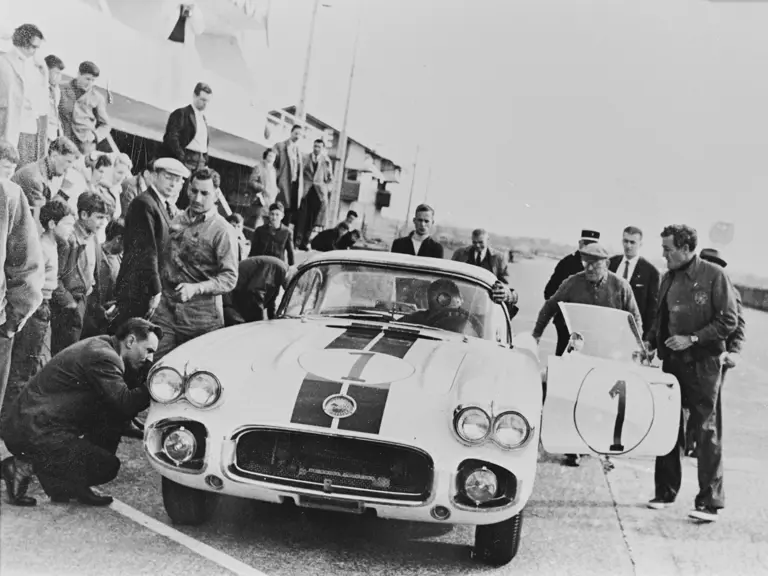
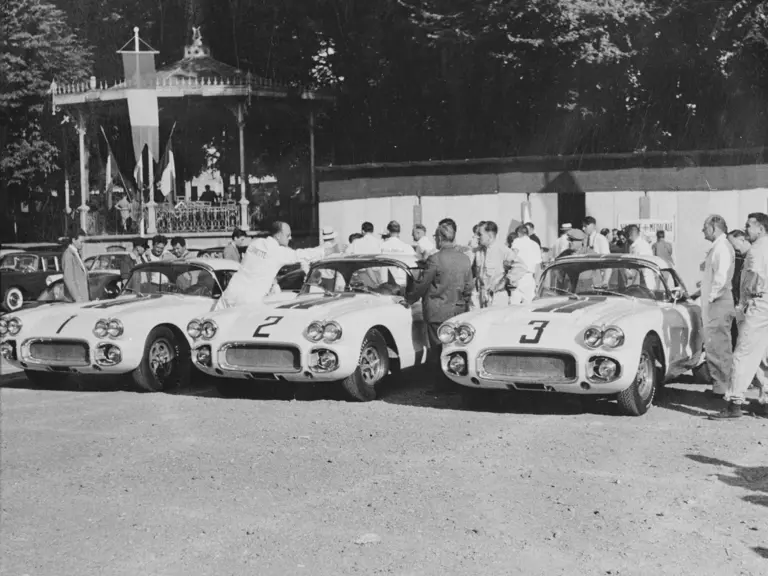
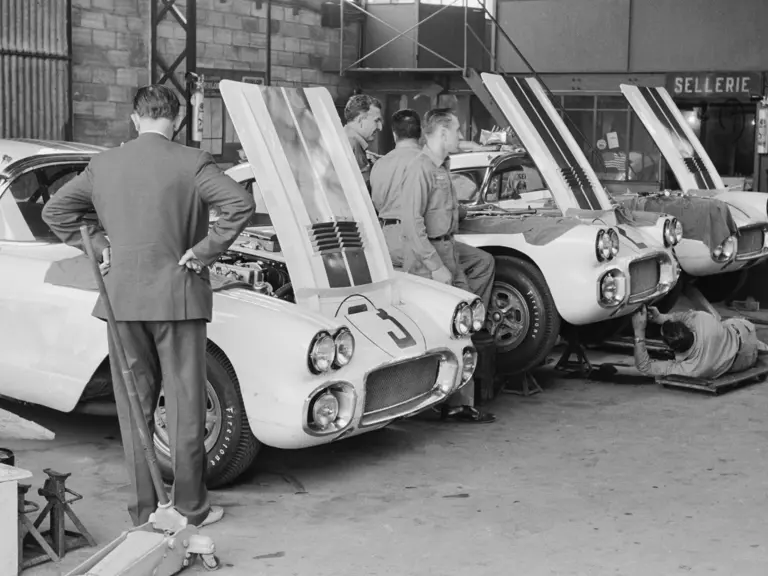
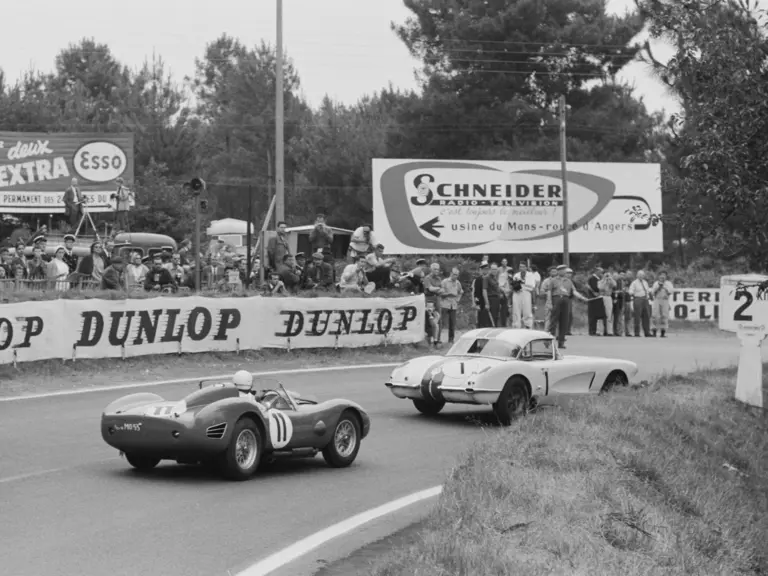
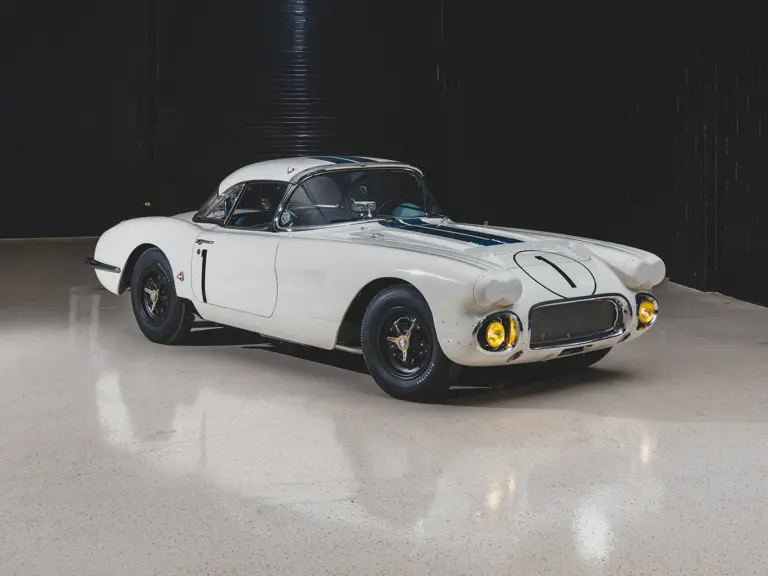
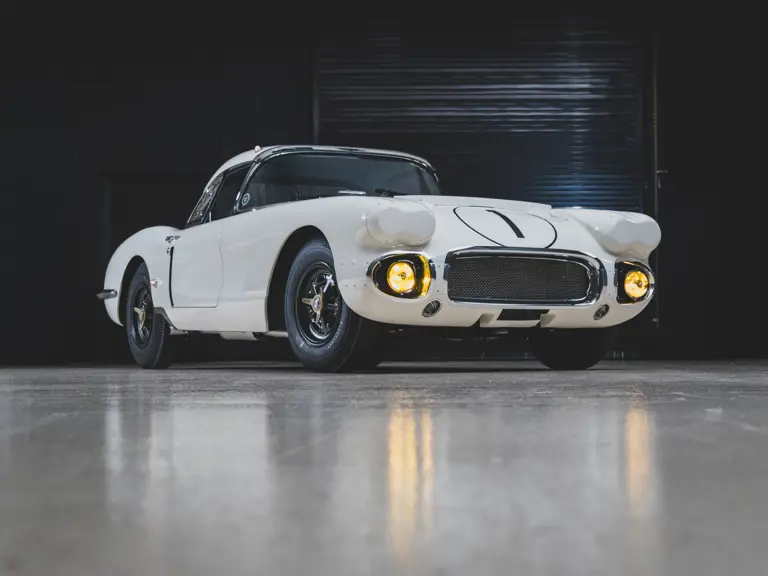
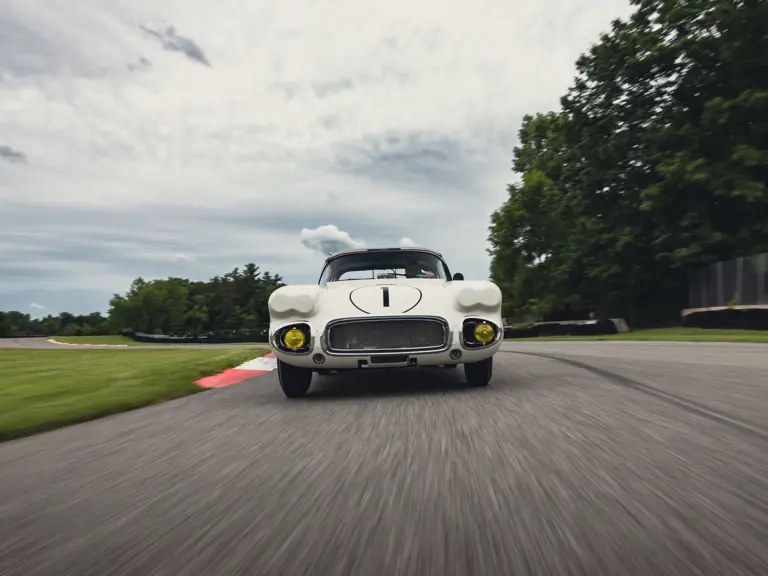
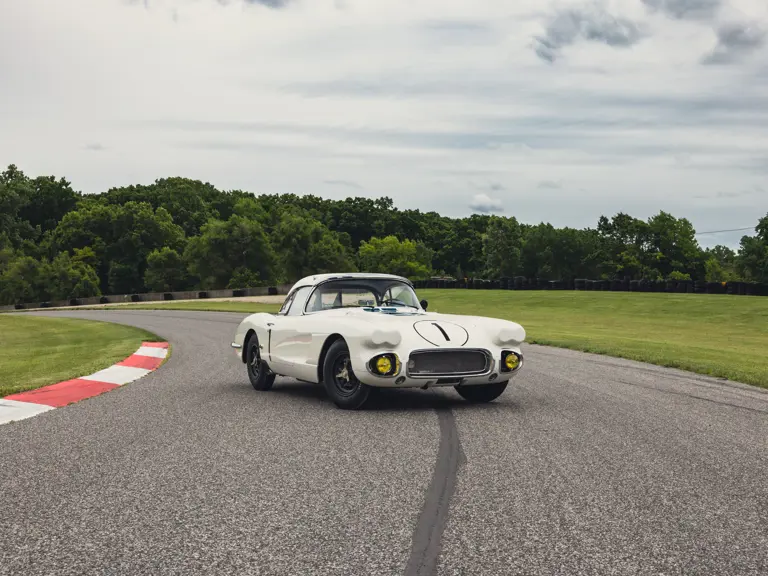
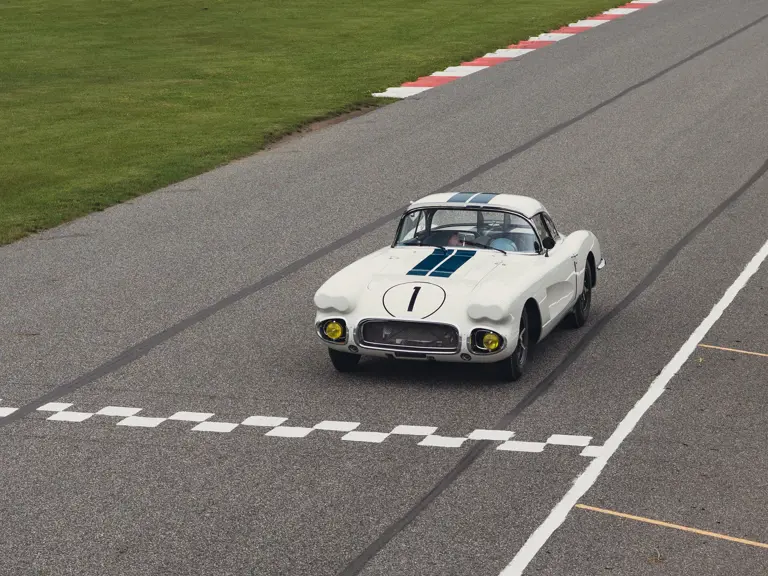
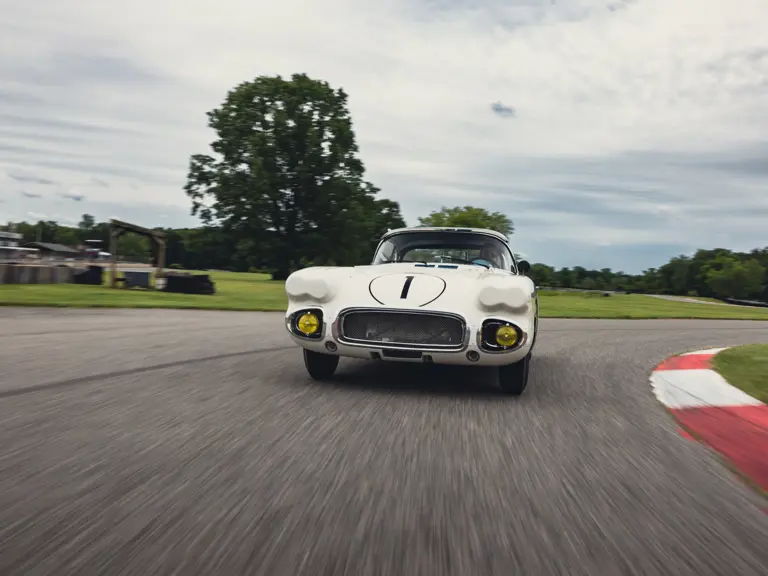
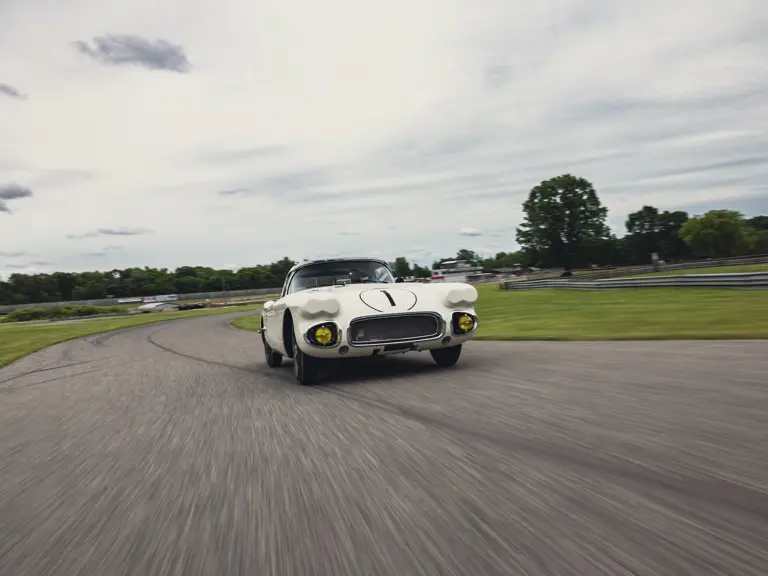
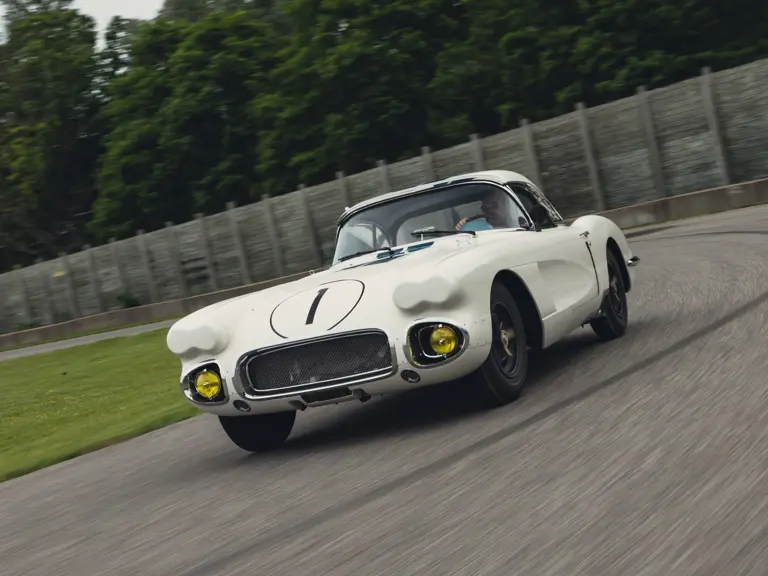
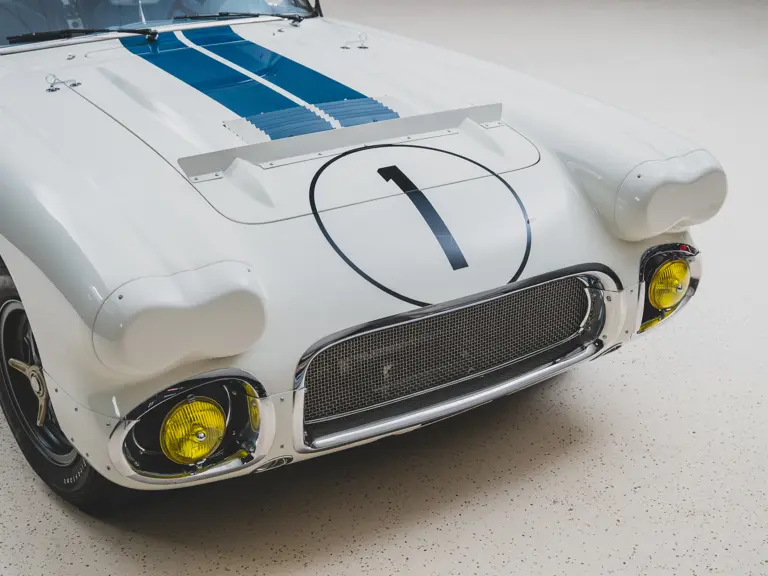
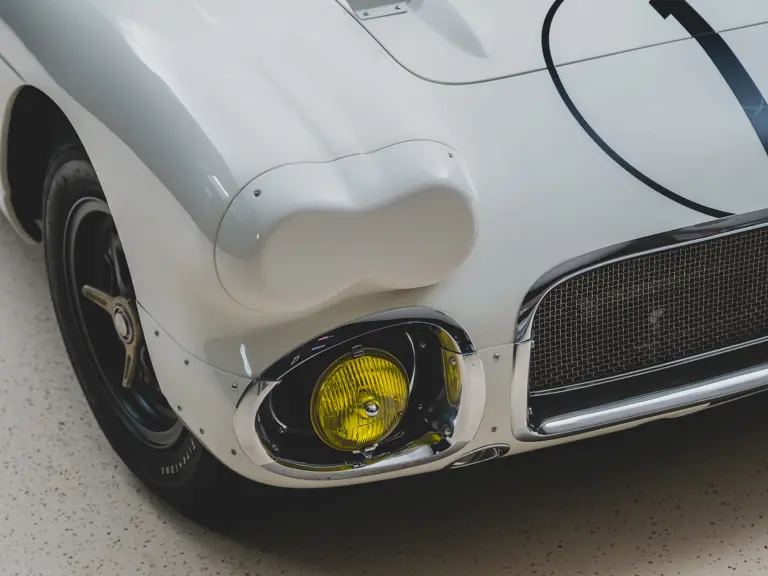
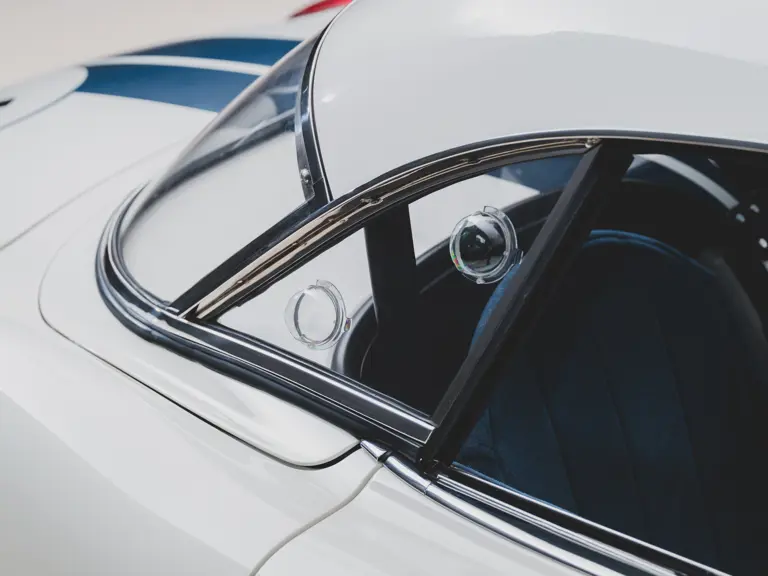
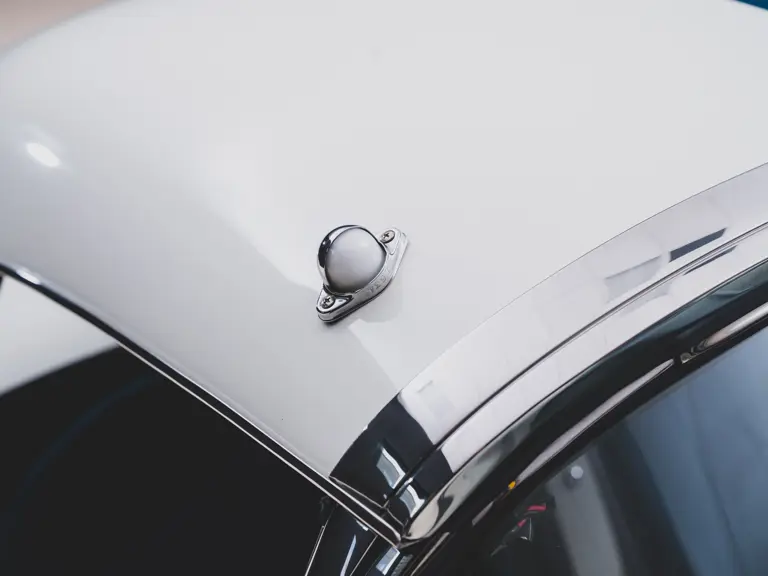
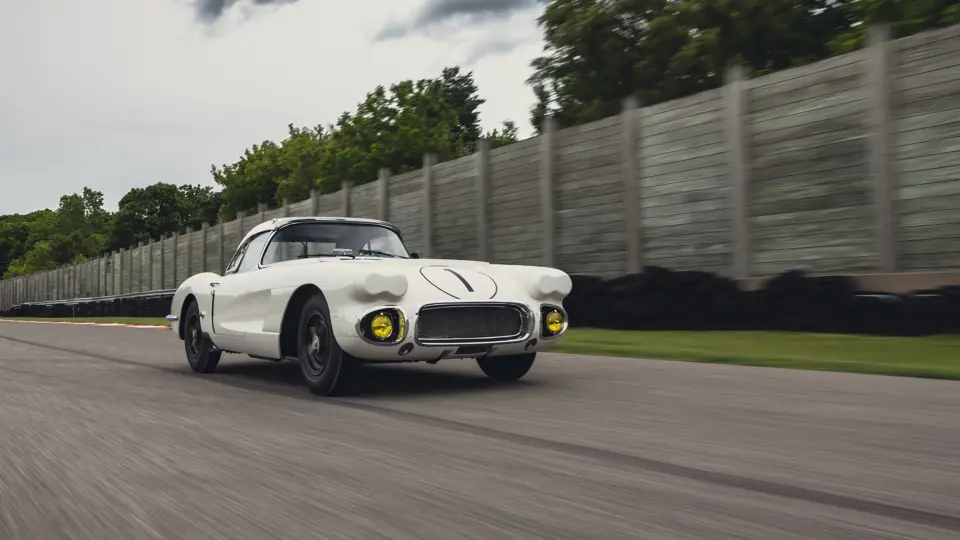
On 8 June 1960, the Cunningham Corvettes set sail aboard the Cunard Line’s RMS Queen Elizabeth from New York to Cherbourg, France. Upon arrival on French shores the three Corvettes were each driven roughly 170 miles from the port to Le Mans. Safe to say, these loud “foreign cars” on the quiet French roads drew lots of attention. Once at Le Mans, the Cunningham team utilized Guillon’s garage for last-minute adjustments. The team cars were assigned numbers for the race with this car, chassis 3535, receiving #1. Chassis 4117 driven by Dick Thompson and Fred Windridge received #2, and chassis 2538 driven by John Fitch and Bob Grossman received #3. Briggs Cunningham found the cars hard to differentiate simply by their numbers at speed, so he assigned colored headlight covers to the cars: #1 received white headlight covers, #2 received blue headlight covers, and #3 received red headlight covers.
Zora Arkus-Duntov’s dream of the Chevrolet Corvette competing at the world’s greatest race went back to the mid-1950s. The dream that was now finally coming to fruition, and with him co-driving one of the entries—or so he thought. Arkus-Duntov and Cunningham had made an agreement that they would co-drive one of the Corvettes for the 1960 race. Chassis 3535 was intended to be that car according to initial Le Mans registration papers, dated 25 May, which prominently listed Arkus-Duntov as co-driver with Cunningham.
When Ed Cole, then General Manager of Chevrolet, caught wind of the driver pairing, he was frustrated to say the least. Cole knew the value of Arkus-Duntov to the Corvette brand. To potentially lose, or risk injuring, the greatest asset behind the marque’s most celebrated model was far too great of a chance to take, especially given the development of the new C2 Corvette underway. Additionally, the optics of a high-ranking GM employee not adhering to the AMA racing ban was negative press that GM wanted to avoid. Cunningham, apparently unaware of the agreement Cole and Arkus-Duntov had to not race, was eventually approached by Cole and told to find another driver. Cunningham replaced Arkus-Duntov with American William Essick "Bill" Kimberly as his co-driver for the #1 car. Arkus-Duntov accepted Cole’s decision, likely with some disappointment as he had run the 24 Hours of Le Mans four times with great success, including 1st in class finishes in 1954 and 1955. Arkus-Duntov, a team player, would still travel to Le Mans to support the Cunningham effort, however what had initially been submitted as two weeks’ vacation to drive the #1 car, was changed to a one week Le Mans business trip and a one week vacation following the race.
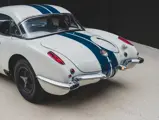
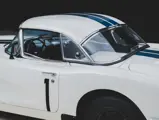
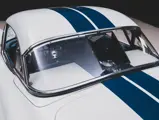
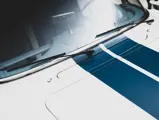
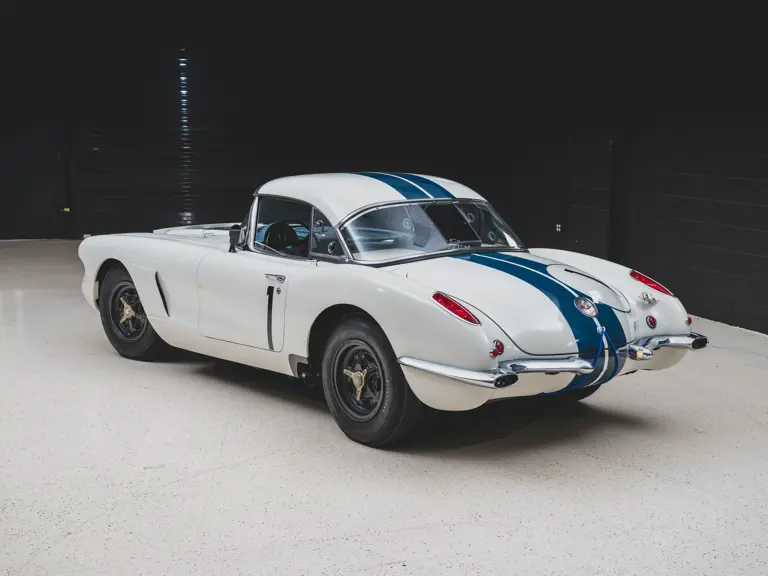
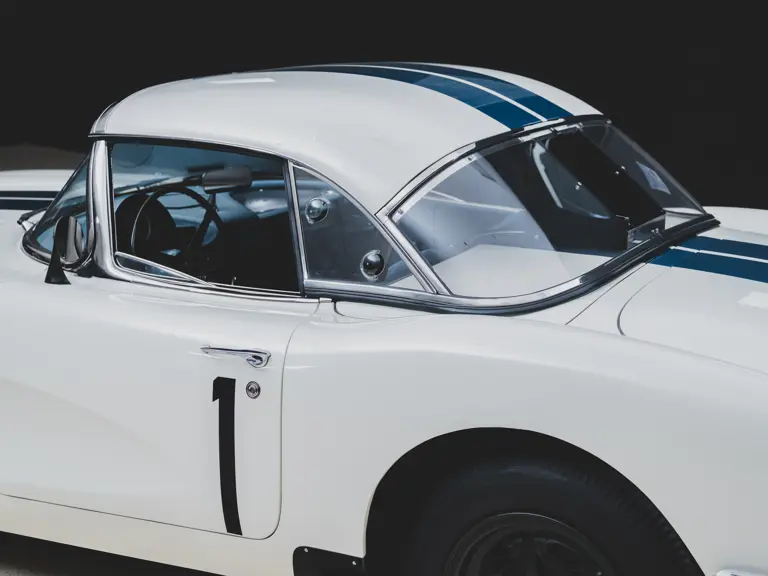
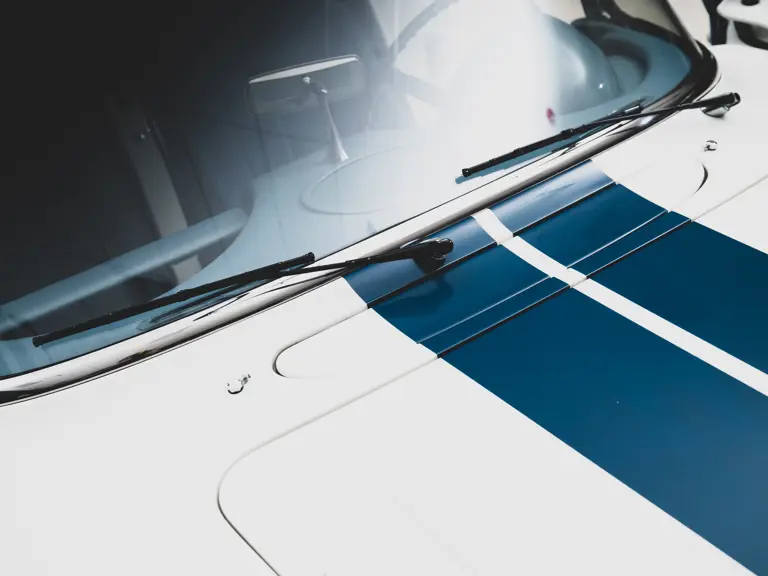
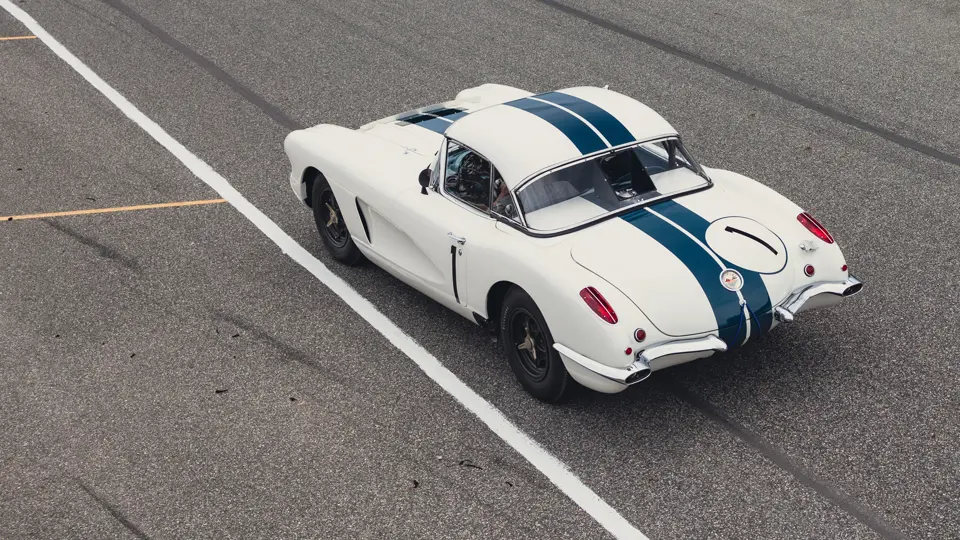
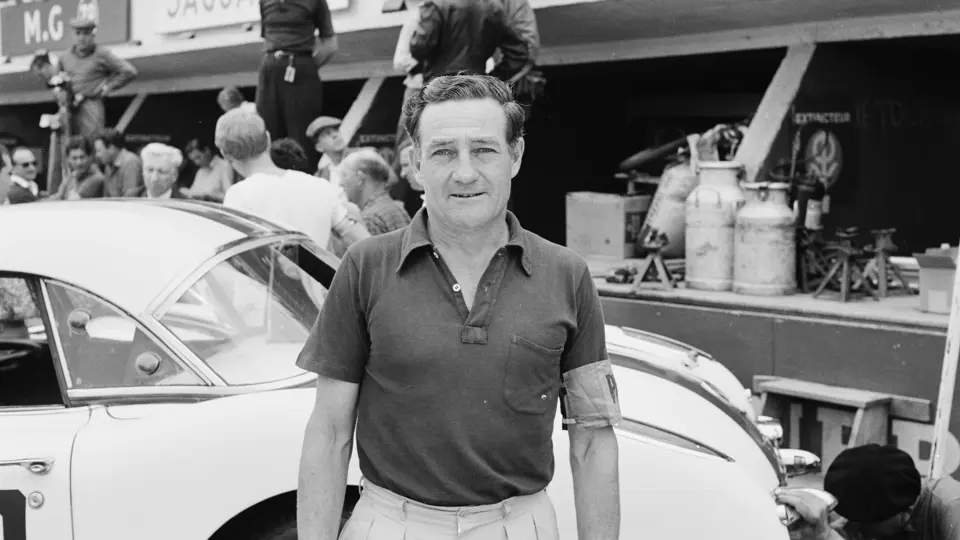
For Cunningham, it was his seventh Le Mans behind the wheel, his best finish having been achieved in 1952 with a 4th overall and 1st in class in his very own Cunningham C-2R. For Kimberly, a gentleman driver whose family co-owned Kimberly-Clark, it was just his second 24 Hours of Le Mans. A good friend of Cunningham, Kimberly had raced for the first time in 1959, piloting his very own Ferrari 250 Testa Rossa. The stage was set for the #1 Corvette, chassis 3535, with two American drivers behind the wheel of an American car, donning the country’s traditional white and blue racing livery.
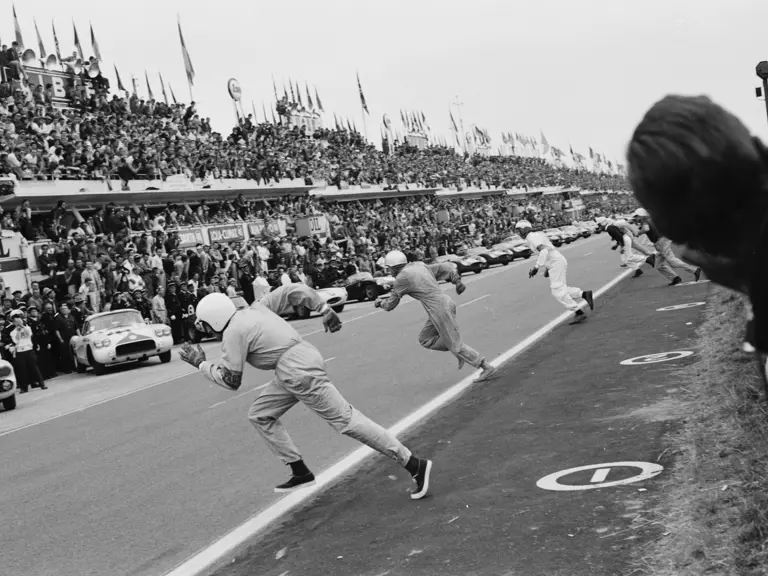
The Cunningham Corvettes started in race number order, 1-2-3, with the Camoradi Corvette starting 4th, and a pair of Jaguars in 5th and 6th. The latter Jaguar, an experimental E-Type predecessor dubbed the E2A, was a fellow Cunningham team entry driven by Dan Gurney and Walt Hansgen that had turned the fastest lap during practice. For the #1 Cunningham Corvette, chassis 3535, Briggs Cunningham would perform the famed running start and take the first stint behind the wheel.
At the beginning of the race the three Cunningham Corvettes remained competitive with the best Europe had to offer. After the first hour the #1 Corvette was in 24th place, the #2 car was in 14th place, and the #3 car was in 18th place. At the end of the second hour Briggs Cunningham had gained a few positions, moving the #1 car up to 21st place, while the other two cars were fighting for positions in the low teens.
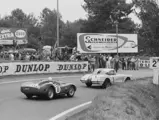
After 26 laps Cunningham pulled the #1 Corvette in for the car’s first pit stop, with Kimberly assuming driving duties and the car receiving fuel and tires. After a 1 minute, 42 second stop Kimberly began his first stint behind the wheel, exiting the pits onto the famed Circuit de la Sarthe. On his sixth lap he powered through the Dunlop bridge, through the esses, Tertre Rouge, and took the Corvette to its limit down the famous Mulsanne straight. He successfully navigated through the challenging turns at Mulsanne corner, Indianapolis, and Arnage with Lloyd “Lucky” Casner in the Camoradi team’s Maserati Tipo 61 hot on his tail.
However, just over the crest of the hill following Arnage, traveling at about 100 mph, Kimberly was met by what he described as “a wall of rain.” The high speed, coupled with the nearly full tank of gas and Firestone “dry” tires, were no match for the wet road conditions. The car hydroplaned, went off track near Maison Blanche, and rolled end-over-end. Luckily the car ended right side-up and Kimberly walked away from the accident unscathed. The car, however, was not as lucky, as damage to the car coupled with an engine fire, which melted ignition wires, ultimately forced its retirement. Circuit de la Sarthe had claimed its seventh car of the race as chassis 3535’s day was over after three hours and 32 laps.
As for the other two Cunningham Corvettes, the rain would later force Dick Thompson in the #2 Corvette off the track at the same corner. The car suffered damage, but Thompson was able to limp it back to the pits where repairs were hastily made. Despite being able to rejoin the race following the accident, Thompson and Fred Windridge’s race in the #2 car would sadly end due to engine failure after 207 laps and with the finish line nearly in sight, in hour 19.
The #3 Corvette soldiered on through the poor weather with John Fitch and Bob Grossman holding a steady pace the entire race. The duo would even climb as high as 7th overall at one point. In the end, the #3 Corvette finished first in the GT-5.0 class and an impressive 8th overall, behind NART’s Ferrari 250 GT SWB driven by Americans Ed Hugus and Augie Pabst and just ahead of Maj. I.B. Baillie’s Aston Martin DBR1.
A RACECAR IN RETIREMENT
On 30 June 1960, the Cunningham Corvettes once again crossed the Atlantic on the RMS Queen Elizabeth, departing from Cherbourg and destined for New York, where they were sent to Momo’s shop. The Le Mans race engines were removed and then returned to Frank Burrell at GM. The three cars were then sold by Cunningham’s friend Bill Frick. Chassis 3535 was sold by Frick “as-raced,” minus the engine and hardtop, to SCCA racer and friend of Cunningham, Marshall “Perry” Boswell Jr. of Delray Beach, Florida.
Under Boswell’s ownership the race-damaged car was repaired and altered. It received a single-headlight style front end similar to the earlier 1956–1957 Corvette, the addition of a European barchetta-styled grille of Boswell’s design, and a hood scoop. The side coves were filled in, and the rear of the car was given a more elegant finish, like that of the Porsche racecars of the 1950s. The Corvette was painted black and a set of chrome turbine wheels with whitewall tires finished off the modified look.
Boswell would sell the car in 1966 to Robert Lee Bollinger, who owned a paint shop in Tampa, Florida. Bollinger painted the car yellow, and he would go on to own it until the early 1970s, when it was sold to Jerry L. Moore, also of Tampa. In 1975, Dan Mathis Sr. would acquire the car, keeping it for less than a week before it was sold to John Lehmuhke, owner of a Tampa Sunoco station. In April 1976 the car was acquired by The Honorable Richard W. Carr Sr. of St. Petersburg, Florida, disappearing from the public eye for nearly four decades.
THE RESURRECTION OF 3535
In 2011 Rick Carr was handling the estate of his late father when he uncovered a unique, burgundy-painted sports car in a warehouse. Carr’s research into his odd find led him to Larry Berman, a Cunningham historian, who confirmed he was in possession of a very special car: the #1 Cunningham Corvette from the 1960 24 Hours of Le Mans, chassis 3535.
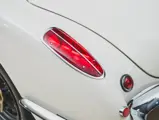
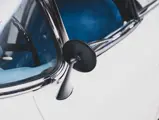
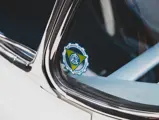
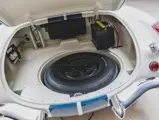
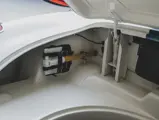
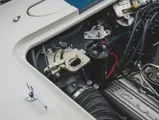
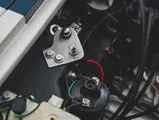
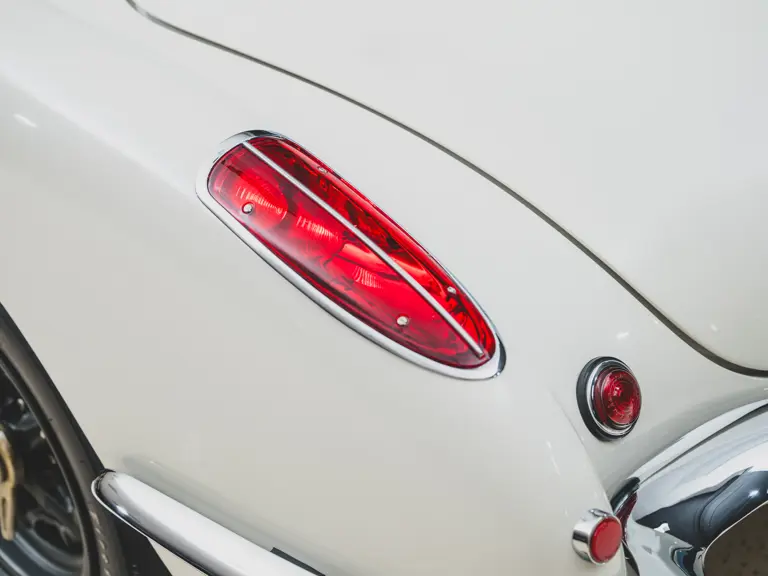
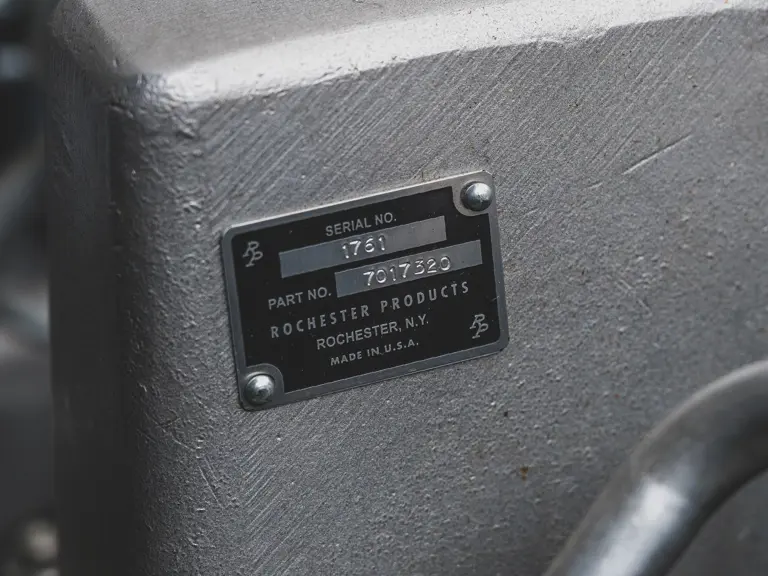
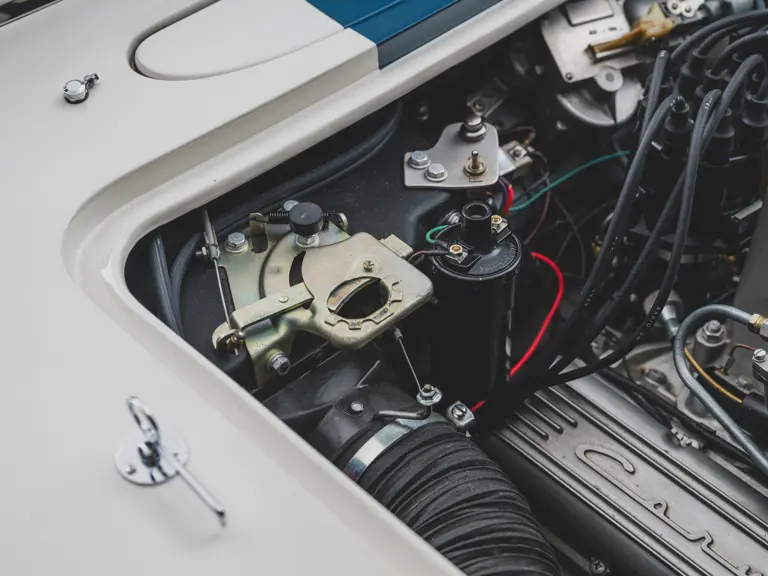
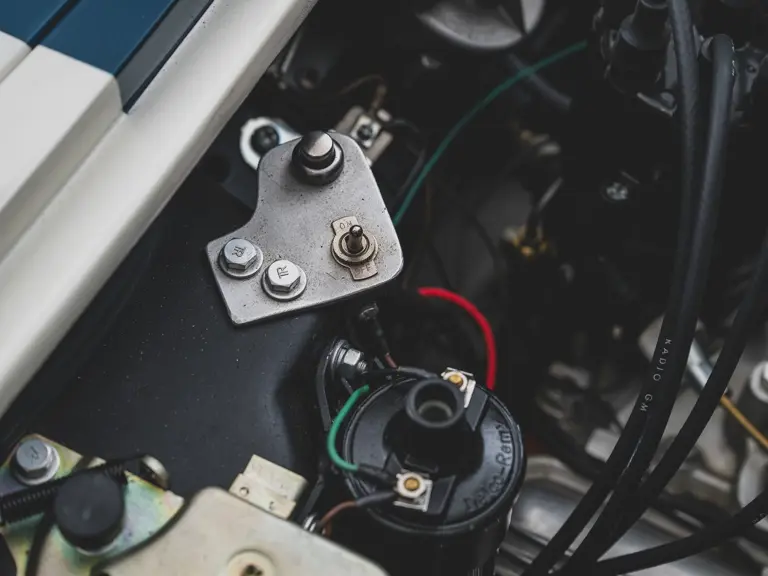
Though modified, the car retained the large fuel tank behind the seats. There was evidence of a relocated center-mounted passenger-side windshield wiper, a patch on the rear decklid clearly covered where the quick-fill Halibrand gas cap once was, and traces of the roundel light on the passenger-side rear quarter just aft of the door were evident. Underbody mounting points were extant for items such as oil coolers, and safety straps and cutouts for the side-exit race exhaust also remained. Even the mounting plate for the Arkus-Duntov-specified remote starter was still on the firewall.
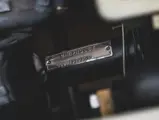
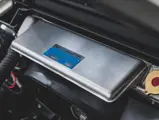
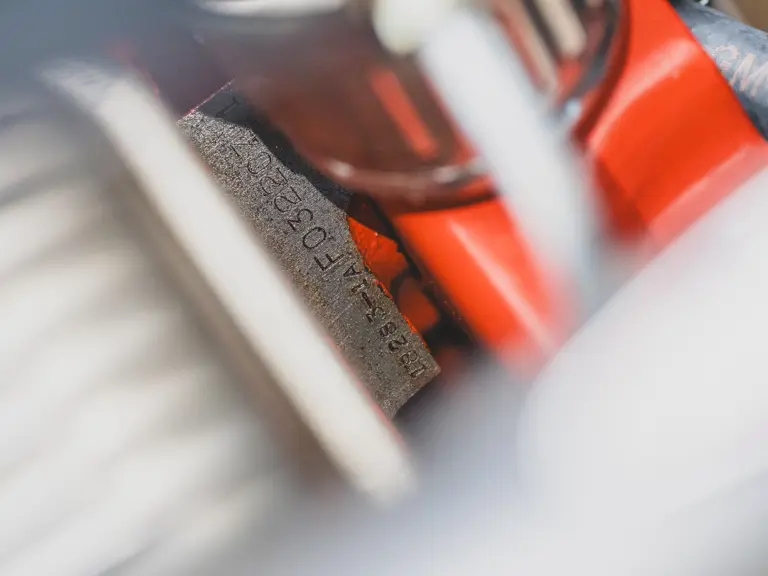
Most importantly, the Corvette displayed the chassis number of the #1 car that ran the 24 Hours of Le Mans, with 00867S103535 recorded on the steering column chassis plate as well as stamped on the frame in Chevrolet’s confidential chassis stamp location under the body. The story of the car’s rediscovery made national news, and it was the cover car with a feature article in the NCRS’s Corvette Restorer Fall 2012 issue.
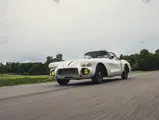
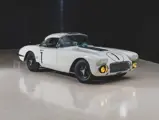
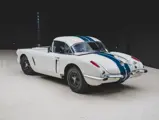
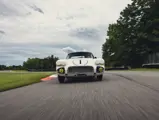
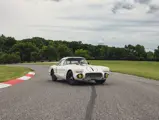
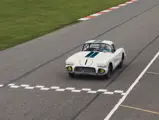
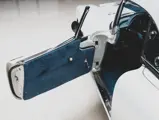
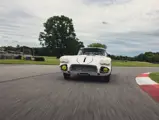
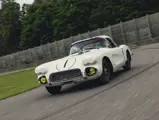
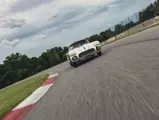
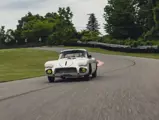
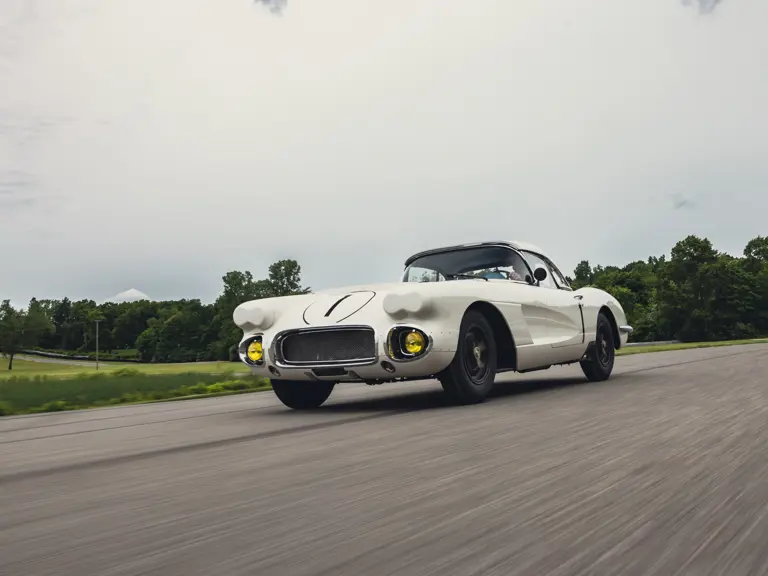
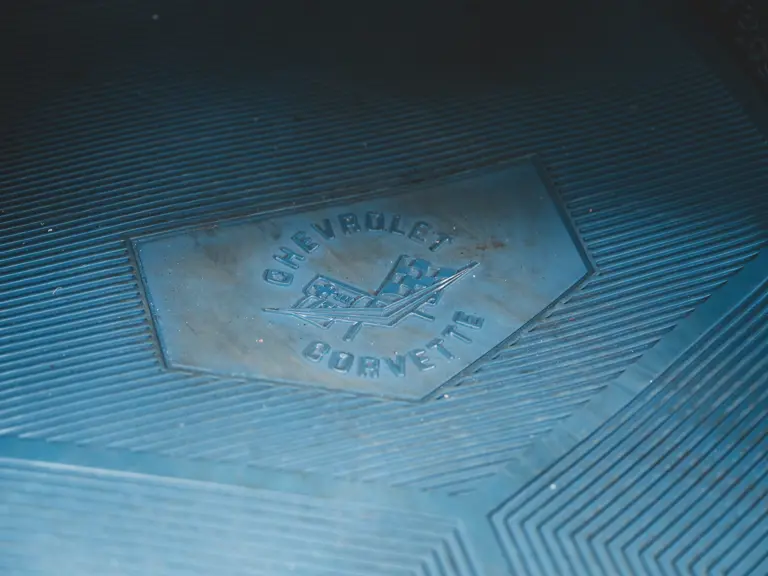
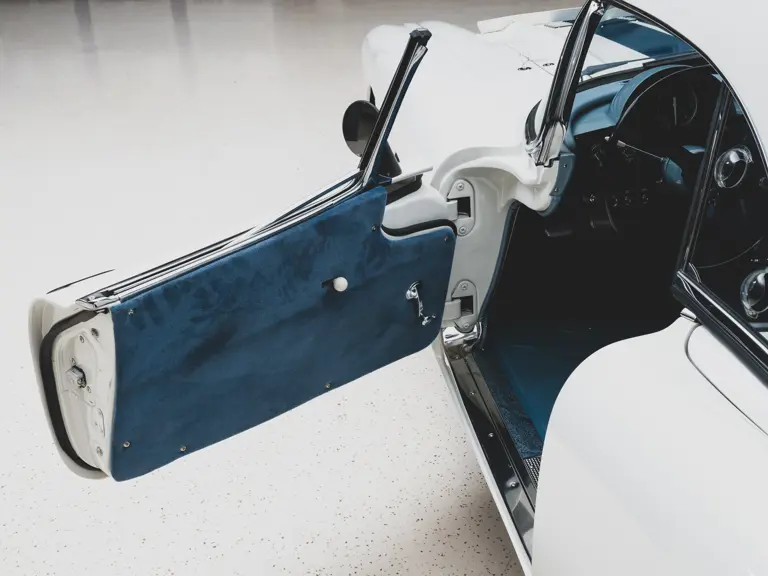
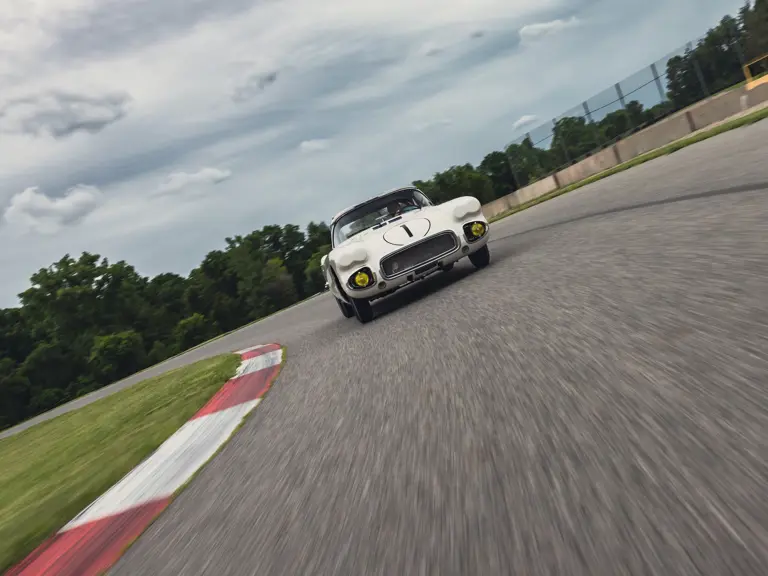
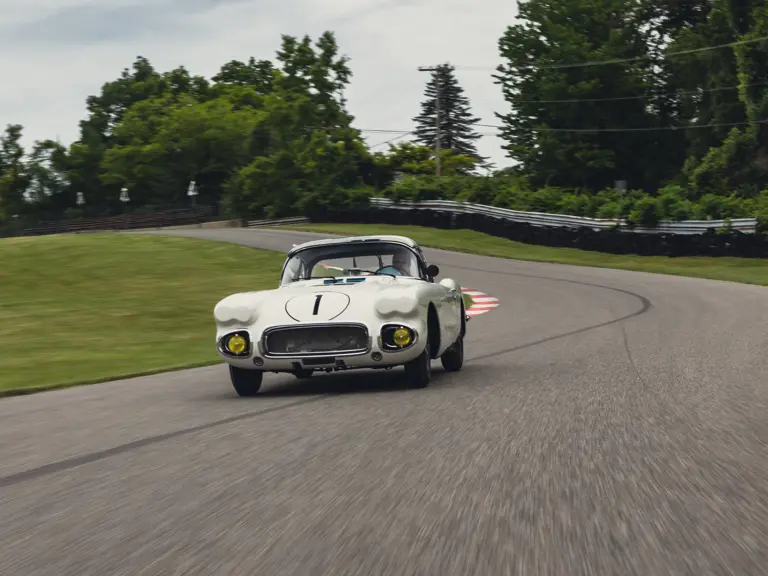
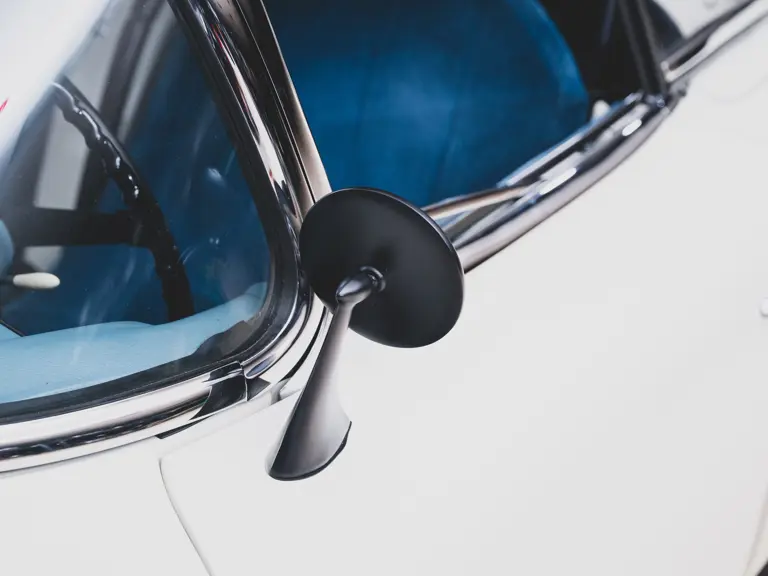
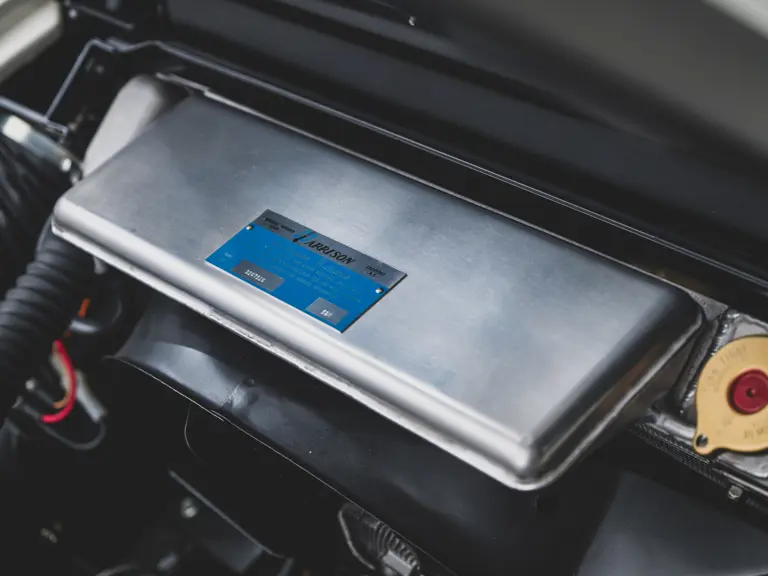
In March of 2021, the project Corvette was reacquired by the Cunningham family. A complete body-off restoration was commissioned, and the car was sent to marque expert Kevin Mackay and his team at Corvette Repair Inc. in Valley Stream, New York. The restoration was completed in 2023 at a cost of over half a million dollars, accurately depicting the car as it graced Circuit de la Sarthe some 66 years ago.
Following the restoration on chassis 3535, the #1 car, was reunited with the two other 1960 Le Mans Cunningham Corvettes, #2 and #3, at The Amelia Island Concours d’Elegance in 2023. Shortly thereafter chassis 3535 was the cover car with a feature story in the NCRS’s Corvette Restorer Spring 2023 issue. In September 2024, the car was invited to be a part of the Corvette Racing Class at the St. Michaels Concours d’Elegance on Chesapeake Bay. The car was once again the cover car in the NCRS’s Corvette Restorer Fall 2024 issue, which covered the 2024 NCRS Convention held in Hampton, Virginia.
Today the Corvette is accompanied by a file outlining the car’s history. It includes copies of the car’s 24 Hours of Le Mans Carnet, correspondence and memos from GM leading up to the race, select photos throughout the car’s history, as well as copies of each NCRS’s Corvette Restorer issue in which it was featured.
For both the great American sportsman Briggs Cunningham and the father of the Corvette, Zora Arkus-Duntov, the 1960 running of the 24 Hours of Le Mans was the realization of a dream that had been many years in the making. Now wearing a stunning, comprehensive restoration by one of the Corvette world’s renowned experts—and as the last of the three Cunningham Corvettes to be fully returned to their as-raced configuration—the #1 car, chassis 3535, is a celebration of American motorsport heritage and a remarkable opportunity for the dedicated collector.
Driven by Briggs Cunningham himself and now proudly offered by the Cunningham family, chassis 3535 represents a pivotal moment in Corvette history, when America’s Sports Car took on Europe’s best on racing’s most famous stage: The 24 Hours of Le Mans.
 | Monterey, California